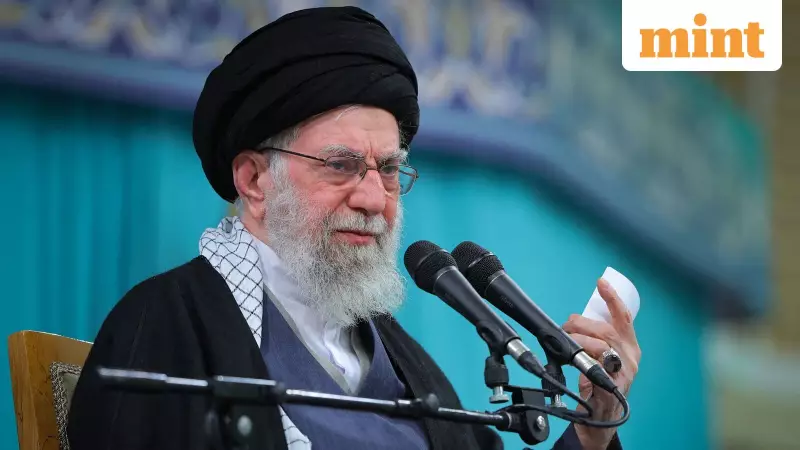
Iran's Supreme Leader Ayatollah Ali Khamenei has reportedly retreated to a secure underground bunker in Tehran, according to opposition media sources, as the Islamic Republic faces escalating tensions with the United States and ongoing nationwide protests that pose a significant challenge to the ruling regime.
Supreme Leader's Underground Move Amid Security Concerns
The Times of Israel, citing information from the opposition-affiliated Iran International news site, reported that Khamenei moved to the fortified bunker after senior Iranian officials assessed an "increased risk of a potential US attack." This assessment followed the deployment of significant US military forces to the region, creating heightened security concerns within Iran's leadership circles.
The bunker facility reportedly contains an elaborate system of "interconnected tunnels" specifically designed to ensure the supreme leader's safety and security during periods of heightened external threats. This underground complex represents one of the most secure locations within Iran's capital city.

Leadership Transition During Crisis Period
While Ayatollah Khamenei remains in hiding, his third-born son, Masoud Khamenei, has reportedly assumed responsibility for day-to-day operations in his father's office. According to the reports, Masoud is now serving as the "main channel for communication" with other government leaders and officials, effectively managing routine governmental functions during this period of heightened security.
This temporary leadership arrangement highlights the regime's contingency planning for crisis situations, ensuring continuity of governance even when the supreme leader's physical security requires extraordinary measures.
US Military Buildup in the Region
The developments in Tehran coincide with significant US naval movements toward the Middle East. A US Navy carrier strike group is currently en route to the region amid renewed threats by President Donald Trump to take military action against Iran's senior leadership.
Speaking to reporters aboard Air Force One on January 23 after returning from Davos, Switzerland, President Trump stated: "We have a big flotilla going in that direction and we'll see what happens. I'd rather not see anything happen, but we're watching them very closely."
Detailed US Naval Deployment
According to Bloomberg, citing two US officials who declined to specify precise locations, the USS Abraham Lincoln aircraft carrier is leading the deployment, accompanied by three Arleigh Burke-class guided missile destroyers: USS Spruance, USS Michael Murphy, and USS Frank E. Petersen Jr.
The carrier strike group was reportedly moving through the Indian Ocean with its air wing including advanced F-35C fighter jets, while the accompanying destroyers are capable of launching Tomahawk missiles, representing significant offensive capabilities positioned near Iranian territory.
Nationwide Protests Challenge Regime Stability
The current tensions occur against the backdrop of nationwide protests in Iran that represent the largest threat to the country's ruling regime in decades. Initially triggered in Tehran by the collapse of Iran's currency, the protests have since spread across the country with demonstrators calling for an end to Supreme Leader Khamenei's leadership.
Despite President Trump scaling back prior threats to strike Iran following alleged assurances that Tehran would not carry out planned executions of protesters, human-rights groups report that the government's crackdown on demonstrations has actually intensified in recent weeks.
Regional Security Implications
Tehran has issued warnings to both the United States and Israel against intervening to support the protests. This comes after Israel conducted strikes on Iranian nuclear facilities last year, adding another layer of complexity to the regional security situation.
The combination of internal unrest, external military pressure, and leadership security concerns creates a volatile situation with potential implications for regional stability and international relations throughout the Middle East.