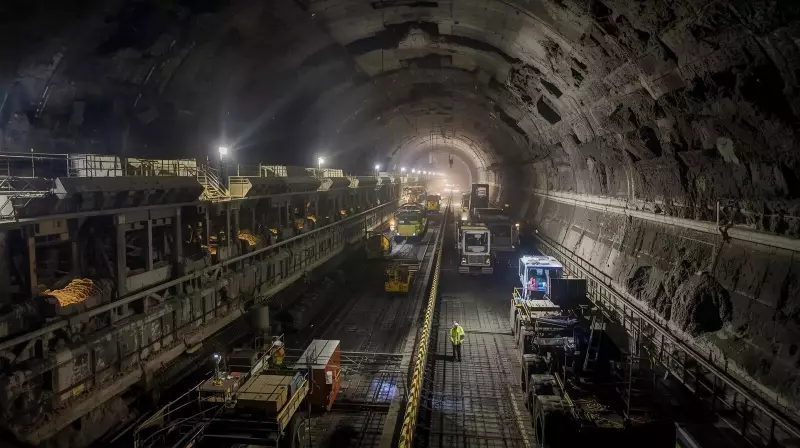
Norway's Ambitious Undersea Tunnel Project Advances Deep Below the North Sea
Norway is pushing ahead with a massive transportation project that remains largely hidden from public view yet carries enormous significance. Construction crews are working deep beneath the North Sea's surface on Rogfast, an undersea road tunnel that will eventually create a ferry-free route along Norway's rugged western coastline.
Engineering at Extreme Depths
The tunnel is currently being carved through solid rock and will stretch an impressive 27 kilometers when finished. At its deepest point, Rogfast will plunge approximately 392 meters below sea level, making it far deeper than any existing road or rail tunnel beneath water. This extreme depth presents unique engineering challenges that teams must overcome daily.
Engineers are excavating the tunnel from both ends simultaneously, with teams working toward each other beneath the seabed. Their goal is to meet with an accuracy margin of less than five centimeters. This precision reduces material waste and avoids expensive corrections, especially considering the enormous volume of rock being removed.

Connecting Coastal Communities
Rogfast stands for Rogaland fastforbindelse, named after the region it serves and the Norwegian term for a fixed link. The tunnel will connect Randaberg and Bokn, forming a crucial segment of the E39 coastal highway. This major road runs more than 1,100 kilometers from Trondheim in the north to Kristiansand in the south.
Currently, drivers must board seven separate ferries to complete this coastal journey. The long-term vision involves eliminating these crossings through a combination of tunnels and bridges. Rogfast represents one of the most complex sections of this ambitious plan and among the first to take physical shape underground.
Advanced Technology Guides Construction
Precision work at such depths relies heavily on sophisticated measurement technology. Laser scanners record newly excavated tunnel sections, capturing millions of data points every second. These measurements create detailed digital models that engineers compare against original design plans.
Even minor deviations can lead to significant increases in material handling requirements. Correcting mistakes underground typically means removing additional rock and reinforcing structures again, adding both time and cost to the project.
Technical Challenges and Solutions
Working hundreds of meters below sea level brings constant pressure from surrounding rock and seawater. One primary technical challenge involves sealing cracks in the rock to prevent saltwater from leaking into the tunnel. Water ingress has already occurred during excavation, prompting teams to focus on improving grouting methods to maintain safe working conditions as tunneling progresses deeper.
The northern section alone spans about nine kilometers and includes the deepest portions of the entire route. Construction teams must constantly monitor and address these pressure-related issues throughout the building process.
Unique Design Features
Rogfast will consist of two separate tubes, each carrying two lanes of traffic. Approximately halfway through the tunnel, drivers will encounter a remarkable feature: a double roundabout situated roughly 260 meters below sea level. This underground junction connects to a branch tunnel leading to Kvitsøy, Norway's smallest municipality.
Air quality inside the tunnel represents another priority for designers. The plan includes a longitudinal ventilation system supported by ventilation shafts. Real-time monitoring systems, cameras, and radar will detect incidents and manage traffic flow once the tunnel becomes operational.
Economic Impact and Timeline
Construction on Rogfast began in 2018 but paused in 2019 due to projected cost overruns. After restructuring, work resumed in 2021, with completion now expected by 2033. The estimated cost stands at approximately 25 billion Norwegian kroner, equivalent to about 2.4 billion US dollars.

While ferry-related employment may gradually decline, improved road access is expected to support other forms of employment, education opportunities, and public services. Lower transportation costs should particularly benefit industries like seafood processing. The tunnel's impact will likely unfold gradually, changing daily routines rather than creating sudden transformations.
Once completed, Rogfast promises to significantly shorten travel times between key cities while reducing dependence on ferry crossings that frequently face weather-related disruptions. This engineering marvel represents Norway's commitment to innovative infrastructure solutions for its challenging coastal geography.