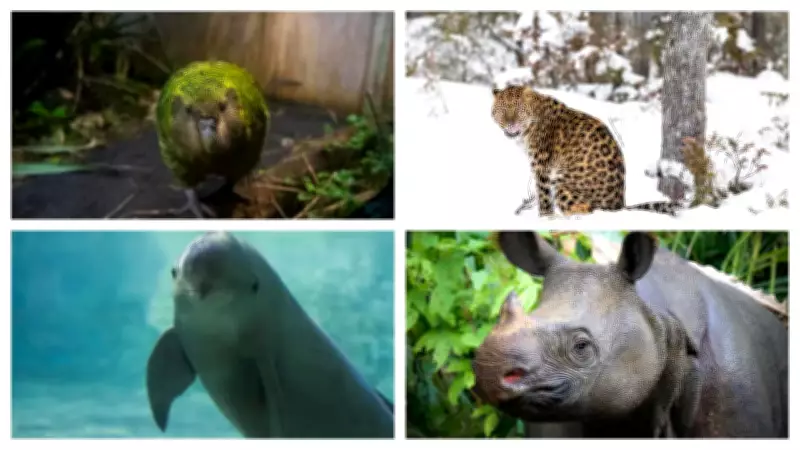
There is no denying that birds, animals, and fishes have been an integral part of the ecosystem, with nature employing mysterious ways to sustain their survival. However, over recent years, certain species are vanishing from the Earth or teetering on the verge of extinction. Extreme commercialization, climate change, natural disasters, and habitat destruction have pushed many unique creatures to the absolute brink. According to conservation data monitored by international and government wildlife agencies such as the U.S. Fish and Wildlife Service (USFWS) and NOAA Fisheries, several critically endangered species now number fewer than 100 individuals in the wild. Their rapidly dwindling populations tell heartbreaking stories. Read on to learn more.
The Kakapo
The kakapo is a large, flightless, nocturnal parrot native to New Zealand. According to the New Zealand Department of Conservation (DOC), the introduction of invasive predators like stoats, cats, and rats nearly wiped out the species, reducing its population to just 51 individuals in the 1990s. Thanks to an aggressive, government-led recovery program that involves isolating the birds on predator-free islands and monitoring every single egg, their numbers are slowly recovering, though they remain precariously low.
The Vaquita Porpoise
The vaquita is the world's smallest and most endangered marine mammal, found exclusively in the northern Gulf of California. Recent revelations indicate that fewer than ten individuals remain. Government monitoring from NOAA Fisheries shows that their numbers have plummeted almost entirely due to illegal gillnet fishing targeting another endangered fish, the totoaba. Despite strict protective laws, these tiny porpoises accidentally drown in the nets, leaving a population that scientists estimate can now be counted on two hands.

The Javan Rhinoceros
Once roaming across Southeast Asia, the Javan rhinoceros has been completely wiped out from mainland Asia. Official audits from Indonesia's Ministry of Environment and Forestry confirm that the remaining population is entirely confined to a single sanctuary, Ujung Kulon National Park, with approximately 70 to 80 individuals left. Because they are restricted to one location, the entire species remains highly vulnerable to natural disasters, disease outbreaks, and severe inbreeding depression.
The Amur Leopard
The Amur leopard is a strikingly beautiful big cat adapted to the harsh, freezing forests of the Russian Far East and Northeast China. Reports from the Russian Federal Ministry of Natural Resources outline that massive deforestation, illegal poaching for their exquisite fur, and a severe loss of prey animals historically decimated their numbers. While strict government anti-poaching patrols have helped the population stabilize slightly, their genetic pool remains dangerously shallow.
The Red Wolf
Native to the southeastern United States, the red wolf is one of the most endangered canids on Earth. According to the U.S. Fish and Wildlife Service, intensive predator-control programs and land development historically drove them to extinction in the wild by 1980. Although government captive breeding and reintroduction programs established a small wild population in North Carolina, vehicle strikes and territorial conflicts keep their numbers critically low.