

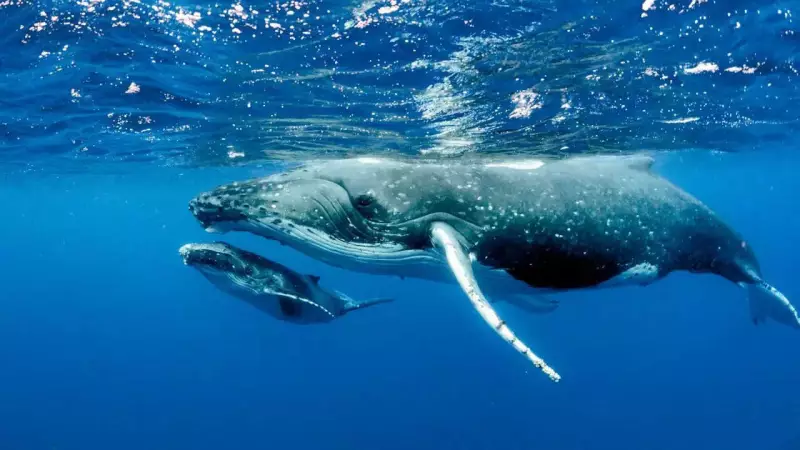
Imagine an animal with a tongue so massive it could tip the scales alongside a full-grown elephant. This isn't a whimsical tale but a stunning reality for the blue whale, scientifically known as Balaenoptera musculus, the largest creature ever to inhabit our planet. Its physical features consistently reflect this monumental size, with one standout attribute being its colossal tongue.
The Tongue That Rivals an Elephant
When pondering the immense qualities of blue whales, their tongue emerges as a prime example of their grandeur. Measuring up to 2.7 metric tons, this organ is equivalent in weight to an African elephant, which typically ranges from 2.5 to 7 metric tons based on age and sex. According to Guinness World Records, the blue whale's tongue holds the title for the heaviest ever recorded in the animal kingdom, firmly placing it in the elephantine category.
More Than Just Size: A Vital Feeding Tool
However, sheer magnitude is only part of the story. The blue whale's tongue is integral to its feeding biology, transforming its enormous mouth into an efficient "planktivore." Unlike predators that hunt single prey, blue whales sustain themselves on tiny, shrimp-like crustaceans called krill, found in oceans worldwide. To gather sufficient nourishment for their massive bodies, which can weigh as much as 180 metric tons, they swim with mouths agape through dense krill swarms.

As water rushes in, the whale's muscular and flexible tongue, along with throat grooves, pushes the water back out through baleen plates. This process traps the krill, which are then swallowed. The tongue's strength and size are essential for processing vast volumes of water to capture enough food, making it a critical feeding apparatus rather than a mere display of bulk.
The Blue Whale's Astounding Dimensions
The blue whale's records extend far beyond its tongue, with its entire body defying imagination. An adult can grow up to 30 metres long—roughly the length of three city buses—and weigh around 180 metric tons. Its heart alone tips the scales at approximately 600 kilograms, and its blood vessels are so wide that a small child could crawl through them. Even the tail fluke spans over 7 metres from tip to tip.
Despite their immense size, blue whales are gentle filter feeders, relying almost entirely on minute krill. This demonstrates that being Earth's largest animal doesn't necessitate being a fierce predator; instead, they use their massive bodies, including the tongue, to efficiently harvest some of the ocean's smallest creatures.
Communication and Navigation Through Sound
Blue whales don't rely solely on size for survival; they also thrive through sound. These giants emit low-frequency sound waves capable of traversing long distances underwater, where sound travels faster than light. As highlighted in a study titled "Singing whales generate high levels of particle motion: implications for acoustic communication and hearing?" published on PubMed Central, these waves are crucial for communication, migration coordination, and possibly navigation.
Researchers believe these calls may also help blue whales locate large krill schools by interpreting sound wave reflections in the water. Essentially, this acoustic ability keeps them connected, oriented, and aware in their vast marine environment, showcasing another layer of their remarkable adaptation.

