

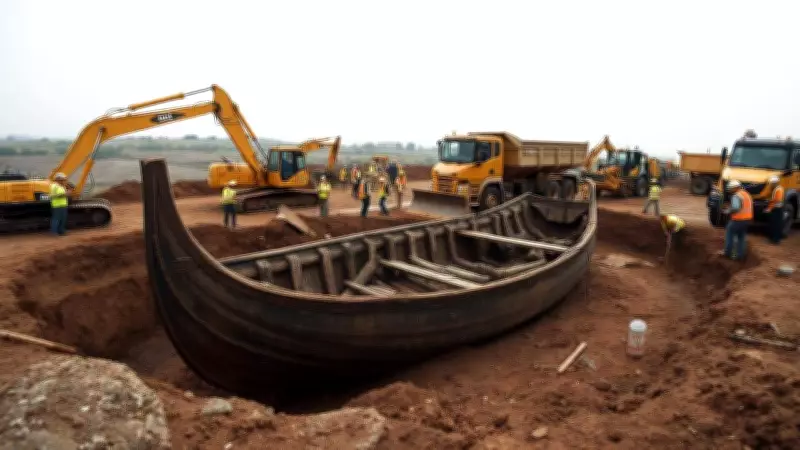
In June 1992, the town of Dover began much as it had for the past century: with the crew of the A20 expansion project engaged in excavation. The air was thick with the pungent smell of asphalt, and the sound of machinery churned near the town's central district. Few anticipated anything beyond pipes or Victorian debris. However, what emerged from the mud was far more extraordinary.
An Unexpected Discovery
As workers manually removed the mud, they realized this was no recent wreck. Rising from the soil was a massive black hull made of sturdy oak planks. The team had unearthed a time capsule: a ship hidden since the Bronze Age, preserved by the same mud that made excavation difficult.
A Monument of Ancient Expertise
This remarkable find, now known as the Dover Bronze Age Boat, is one of the world's most important maritime archaeological discoveries. Unlike modern vessels, it was not constructed with nails or screws but was stitched together. Researchers at the Canterbury Archaeological Trust determined that the boat was built from oak planks connected by yew stitches. Its immense size astonished historians. According to the Dover Museum, it is the world's oldest known seagoing boat, designed to carry significant cargo and a large crew. This proves that 3,500 years ago, the people of Britain were not primitive settlers but skilled woodworkers and sailors. The discovery highlights advanced woodworking and seafaring, indicating a thriving marine culture long before the Romans arrived.

Suddenly, the understanding of early European life was transformed. Without the Dover boat, many historians believed that sophisticated boat construction and engineering emerged much later. However, the boat's existence demonstrates that a complex marine culture thrived in Britain well before Roman occupation, involving frequent trade and travel across a vast sea highway for exchanging goods and communicating with neighboring communities.
Preserving the Past
After the discovery, the greatest challenge was not excavation but preservation. The artifact had remained intact for over three millennia due to the lack of oxygen in the soil, which prevented decay. Once exposed to atmospheric oxygen, the remains would deteriorate into dust within days. Historians and archaeologists raced against time, collaborating with road construction teams to save the find.
According to Dover Museum records, the boat had to be cut into sections for safe removal. These pieces were submerged in a special wax solution for years, replacing water in the wood cells to stabilize the structure for eventual display. This massive conservation effort ensured that ancestral craftsmanship could be studied by future generations rather than lost to the elements.
Legacy and Significance
Today, the boat is displayed in its own dedicated room at the Dover Museum, serving as a reminder of how close ancient history lies beneath modern concrete. For Dover's citizens, it is a source of pride, representing a strong connection to a maritime culture spanning over three millennia. It symbolizes the evolution of human innovation, from simple road-building projects to uncovering incredible prehistoric artifacts.
The Dover Bronze Age Boat is a powerful example of how contemporary development can reveal the oldest secrets from deep within the earth. It prompts wonder about what other secrets may lie beneath the asphalt we drive on. For the men who uncovered it in 1992, it was a turning point in their lives and careers, making it personally invaluable.






