

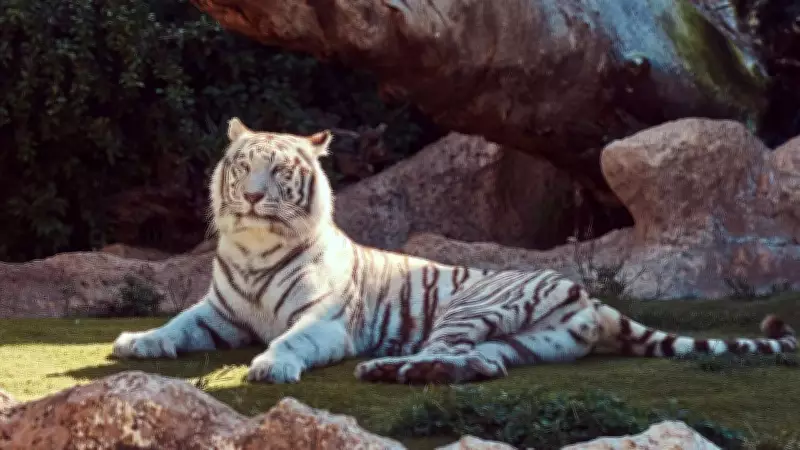
Deep within the rugged, dense forests of Madhya Pradesh lies a royal history that changed the landscape of world wildlife forever. Every white tiger across the world's zoos traces its origin back to this royal secret. Here is an untold tale of a white tiger.
The Big Cat That Turned into a Royal Obsession
Long before it became a global symbol of exotic beauty, the white Royal Bengal tiger was a mythical whisper in the heart of India. The untold story of these white predators is inextricably bound to the Princely State of Rewa and its rulers, who transformed a chance encounter in the wild into a royal obsession, sparking a genetic legacy that eventually reached every corner of the earth.
The Mystical Encounter in the Wild
Nature has some of the most mystical creations, and this untold tale became the origin of one of the most beautiful tiger races. The legend began on a scorching summer day in May 1951, when Maharaja Martand Singh of Rewa led a hunting session into the dense jungles of Bandhavgarh. While hunting a normal brown-hued tigress, he eventually found her with a litter of four large cubs. Surprisingly, one of the nine-month-old cubs stood out like an apparition, sporting a snow-white coat with dark chocolate stripes and piercing ice-blue eyes that immediately allured the Maharaja, and he decided to rescue the cub. While the mother and the other normal orange cubs were shot down in accordance with the tragic hunting traditions of the era, the Maharaja was completely transfixed by the pale cub. He ordered his men to capture the young male alive, determined to bring this genetic marvel back to his grand estate. The cub was brought to Govindgarh and placed inside an unused, secure courtyard, where the King gave him a name that would echo through history: Mohan!

Creating the Royal Lineage
Life inside the palace was a mix of confinement and royal pampering, but Mohan was not an easy animal to tame. In his early months, the wild cub actually broke out of his enclosure at the Govindgarh Palace, sparking a frantic royal search until he was recaptured in the nearby Mukundpur woods. Over time, Mohan settled into his royal prison, recognizing the voice of Maharaja Martand Singh, who trekked nearly 20 kilometers almost every day just to visit his prize tiger. The Maharaja’s ultimate goal was to ensure Mohan’s rare white coat did not die with him. He first bred Mohan with a normal wild tigress named Begum, but nature refused to cooperate—three separate litters resulted in nothing but normal orange cubs. Realizing the white trait was a recessive gene, the palace resorted to a controversial breeding strategy, pairing Mohan with his own orange daughter, Radha, who carried the hidden white gene. The gamble worked, and in 1958, Radha gave birth to four perfectly white cubs, establishing the world's very first captive line of white tigers.
Creating a Legacy
From that single courtyard in Madhya Pradesh, the descendants of Mohan quickly became international currency. The Rewa royal family gifted and sold these exotic white cubs to global leaders, prestigious zoological parks, and foreign museums. One of Mohan’s offspring was famously sent to US President Dwight D. Eisenhower, while others went on to populate zoos from Bristol to Singapore, making Mohan the single ancestral father of virtually every captive white tiger alive today.
The Reality of White Tigers
Despite popular belief, white tigers are not a separate species, nor are they albinos. They are Bengal tigers born with leucism—a rare genetic mutation that causes a lack of orange pigment. Because all captive white tigers stem from Mohan’s immediate family tree, the heavy inbreeding required to preserve their color has left modern populations prone to severe health complications, weak immune systems, and physical defects. Mohan lived out a long, celebrated life under the care of the Rewa royals, finally passing away in December 1968 at the age of twenty. The Maharaja and the local people of Rewa were so moved by his loss that the legendary tiger was given a grand send-off with traditional Hindu final rites. Today, Mohan’s physical form remains stuffed and mounted inside the Baghel Museum in Rewa, his frozen blue eyes serving as a quiet reminder of a bygone royal era that unlocked one of the forest's most beautiful mutations.






