

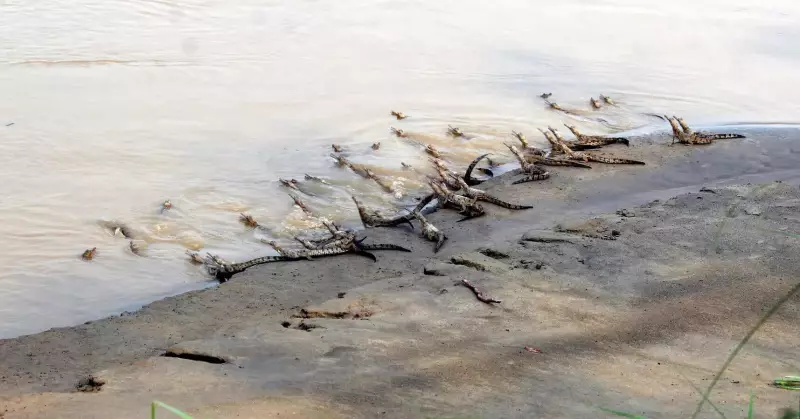
Gandak River Rises as India's Second Largest Gharial Sanctuary
The Gandak river, flowing along the India-Nepal border through West Champaran district of Bihar, has achieved a remarkable conservation milestone by emerging as the second major river in India with the highest number of gharials, following only the Chambal river. These fish-eating crocodiles, once critically endangered, have found a thriving sanctuary in this vital waterway.
Conservation Success Story: From 54 to Over 1,000 Gharials
According to forest officials, sustained joint efforts by the Wildlife Trust of India (WTI) and Bihar's forest and environment climate department have led to a dramatic increase in the gharial population within the Gandak river ecosystem. The numbers tell an inspiring story of recovery:
- The population of adult or large gharials has surged from just 54 individuals in 2015 to over 400 in 2025
- Systematic conservation and release programs have pushed the total gharial population, including juveniles and hatchlings, beyond 1,000 individuals
- This makes the Gandak the second-largest gharial habitat after the Chambal within the species' distribution range across India, Nepal and Bangladesh
For comparison, the Chambal river currently houses over 2,400 gharials, making the Gandak's achievement particularly significant in conservation terms.

Favorable Habitat and Strategic Management
West Champaran conservator of forests and field director Neshamani K explained that the Gandak river, which flows through the Valmiki Tiger Reserve, provides exceptionally favorable conditions for aquatic life and is therefore ideally suited for gharial conservation. He highlighted that improved management and focused conservation measures have resulted in an impressive annual growth rate of 20 to 22% in the river's gharial population.
The data from 2015 to 2025 reveals an extraordinary overall increase of approximately 588% in the number of adult gharials in the Gandak. This represents a dramatic turnaround from the situation in 2010-11 when only 10 gharials were sighted in the entire river system.
Historic Release Programs and Global Recognition
Between 2015 and 2025, conservationists released as many as 944 gharials into the Gandak after hatching along a 326-kilometer stretch from Valmikinagar to Sonepur. This included 212 individuals released in 2025 alone, demonstrating the ongoing commitment to population recovery.
Co-project investigator of the Gandak Gharial Recovery Project, Samir Kumar Sinha, emphasized the river's historic role in gharial conservation. "In 1975, eggs collected from the Gandak were used to initiate India's first captive breeding and release program at the gharial conservation unit in Tikarpada, Odisha," he noted.
Today, thanks to sustained efforts by the Wildlife Trust of India in collaboration with Bihar's department of environment, forest and climate change, the Gandak has earned international recognition. The International Union for Conservation of Nature (IUCN) now recognizes it as one of the six major gharial habitats worldwide.
From Critically Endangered to Recovery
Sinha provided crucial context about the species' global status, explaining that gharial populations had declined by nearly 98% historically. Between 1997 and 2006 alone, a 58% reduction in the adult population was recorded, leading to the species being classified as "critically endangered" in 2007.
However, the latest IUCN assessment in 2019 showed encouraging signs of recovery, estimating around 650 breeding adult gharials worldwide. Importantly, Sinha clarified that gharials are non-aggressive by nature and do not pose any threat to humans, addressing common misconceptions about these remarkable reptiles.
Community-Based Conservation Approach
The success of the Gandak gharial recovery program stems from a carefully designed, community-involved conservation strategy:

- Nest protection begins with identification of gharial breeding congregation sites through river surveys conducted from early to mid-February
- These sites are regularly monitored by local communities, volunteers and WTI biologists
- Female gharials begin trial nesting from late March to early April, followed by actual nesting and egg-laying
- The gharial project team locates active nests and assigns nest watchers from nearby communities to protect them from predation, erosion and trampling
- Frontline forest department staff provide essential support throughout this process
For nests located in erosion-prone areas, trained team members carefully relocate them away from the riverbank into hand-dug nests. These relocated nests are monitored until successful hatching after an incubation period of 60-70 days with assistance from the project team. The hatchlings are then released into the river near the mother, who often remains in the vicinity awaiting them.
A Model for Endangered Species Recovery
Sinha emphasized that "the recovery of gharials in the Gandak river clearly demonstrates that even critically endangered species can be brought back if conservation actions are strategic, inclusive and focused on addressing site-specific threats."
The success has been achieved through the combined efforts of the Wildlife Trust of India, the forest department and local communities with a strong emphasis on improving breeding success and ensuring long-term protection. This collaborative model offers hope for other endangered species conservation efforts across India and beyond.
