

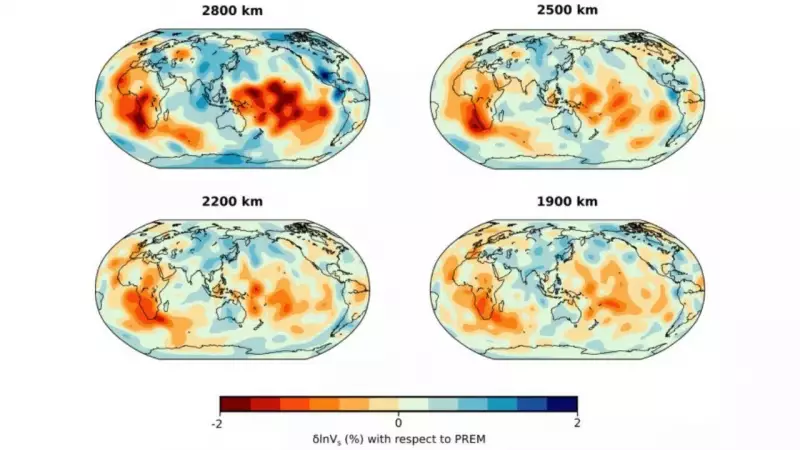
Deep beneath the vast continent of Africa, scientists have uncovered a geological mystery that seems almost otherworldly. Two colossal structures, buried thousands of kilometres down in the Earth's mantle, have been detected. Their sheer size and strange properties are so unusual that they appear not to belong to our planet, presenting a fascinating puzzle for geologists and planetary scientists.
The Discovery of Earth's Hidden Giants
These massive formations were not found by drilling—they lie far too deep for that. Instead, researchers discovered them by analysing the behaviour of seismic waves generated by earthquakes. As these waves travel through the Earth, their speed changes depending on the temperature, density, and composition of the material they pass through. In specific zones under Africa and the Pacific Ocean, the waves slow down dramatically.
These areas are scientifically known as Large Low Shear Velocity Provinces (LLSVPs). The African structures are particularly immense, extending for hundreds of kilometres within the mantle. Advanced global seismology and a dense network of seismometers have now allowed scientists to map these deep-Earth features in unprecedented detail, revealing sharp boundaries that suggest they are distinct, long-lived entities.

Unraveling the Origin: A Tale of Ancient Oceans
So, what are these mysterious blobs? A pivotal study published in Springer Nature provides a compelling, Earth-bound explanation. The research suggests these African structures are primarily composed of ancient oceanic crust that was forced down into the mantle over hundreds of millions of years. This process, called subduction, occurs when one tectonic plate slides beneath another.
The subducted crust, which is denser than the surrounding mantle rock, accumulated near the boundary between the Earth's core and mantle. It did not fully mix back in. This accumulated pile of chemically distinct, dense material is what slows the seismic waves, creating the signals scientists observe. This theory aligns with laboratory experiments on minerals under extreme pressure and our understanding of plate tectonics, pointing to an internal planetary origin rather than an extraterrestrial one.
Why Are Africa's Deep Structures So Unusual?
The African LLSVPs stand out for several reasons. While they are likely hotter than their surroundings, their uniqueness isn't just about temperature. Their chemical composition is different, rich in iron-bearing minerals that likely evolved from the recycled oceanic crust. This affects their density and viscosity, influencing how they interact with the slow, churning flow of the mantle.
Their well-defined edges and persistence over geological time are especially intriguing. The mantle is constantly convecting, yet these structures have remained largely intact, like stubborn islands in a slow-moving stream. This resilience is what initially sparked comparisons to foreign objects trapped inside our planet.
Surface Impacts: Volcanoes and Planetary Dynamics
The influence of these deep giants is not confined to the depths. They are believed to be connected to mantle plumes—columns of hot material rising toward the surface. These plumes can cause volcanic activity, potentially explaining regions of volcanism and large igneous provinces in Africa.
Beyond volcanoes, these structures may play a role in how heat escapes from the Earth's core. Their insulating properties could influence the geodynamo—the process that generates our planet's protective magnetic field. Therefore, understanding these hidden formations is crucial not just for regional geology but for grasping the fundamental processes that maintain Earth's stability over billions of years. As seismic imaging technology improves, these enigmatic structures beneath Africa will remain central to unlocking the secrets of our planet's layered interior.

