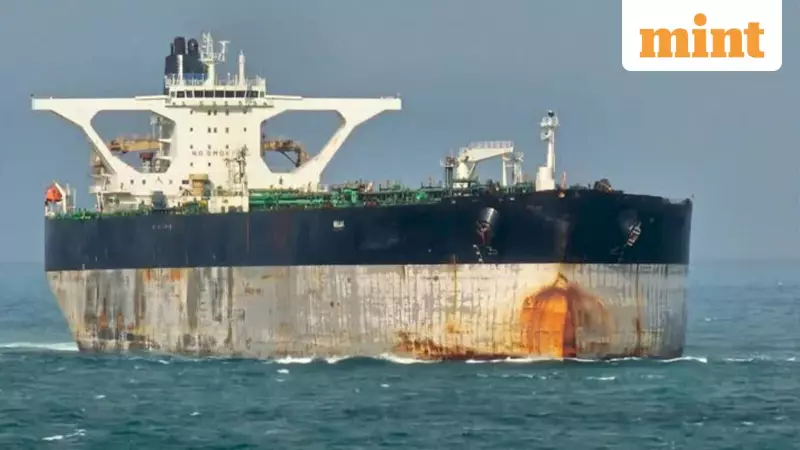
In a dramatic escalation on the high seas, the United States Coast Guard's nearly two-week pursuit of a sanctioned oil tanker has taken a bizarre turn. The vessel, the Bella 1, has attempted to claim Russian protection by having a flag of Russia sloppily painted on its side, according to senior U.S. officials. This move complicates Washington's efforts to seize the ship as part of its campaign to choke off Venezuela's oil revenue.
A High-Seas Chase and a Sloppy Paint Job
The chase began around Venezuelan waters over ten days ago. Coast Guard vessels have been tracking the very large crude carrier across the Atlantic Ocean. As of the latest reports, the sanctioned supertanker is visually in sight, just half a mile away from U.S. military vessels. Officials state they are prepared to forcibly board and seize the tanker, but await a final green light from the White House.
The appearance of the crudely painted Russian flag introduces a significant legal and diplomatic hurdle. Under the United Nations Convention on the Law of the Sea, boarding a foreign-flagged vessel is more complex than boarding a stateless one. Maritime law experts note that merely painting a flag does not automatically grant a ship that nationality. "The U.S. is likely working through diplomatic channels to determine if it’s actually registered in Russia," said retired Rear Adm. Fred Kenney, a former International Maritime Organization legal director.

The Stakes: Venezuela's Oil and Shadowy Networks
The Bella 1 is resisting the U.S. policy of seizing sanctioned oil tankers heading to and from Venezuela. President Trump has advocated for a complete blockade of such vessels to cut off the principal income stream for the government of Nicolás Maduro. The U.S. accuses Venezuela of flooding America with drugs, a charge Maduro denies, counter-accusing Washington of "naval piracy."
This pursuit is part of a broader U.S. military buildup in the Caribbean, which has included deadly strikes on alleged drug-running boats. Since December 10, the U.S. has successfully seized two other tankers carrying Venezuelan oil, whose crews did not resist.
However, the Bella 1's case is distinct due to its alleged connections. The U.S. Treasury Department sanctioned the tanker for allegedly carrying black-market Iranian oil on behalf of U.S.-designated terrorist organizations like Hezbollah and the Houthis, linked to Iran's Quds Force. Retired Rear Adm. William Baumgartner suggested the crew's defiant behavior indicates they are "probably getting orders from somewhere." He added, "These are owned by very bad people trying to make money in a particular manner."
Legal Tangles and Future Confrontations
The situation presents several dilemmas for U.S. authorities. The tanker is old and currently empty, leading to internal debate within the Coast Guard and Navy about the necessity of its capture. Furthermore, international law typically forbids ships from changing flags mid-voyage unless ownership or registration changes.
Eugene Fidell, a Yale Law School scholar, speculated that Russia might be waiving formalities to "jerk the U.S. around." Meanwhile, the standoff continues. The Bella 1, owned by Turkey-based Louis Marine Shipholding Enterprises (which did not comment), made an unusual U-turn last weekend and fled at full speed.
Despite Trump's call for a blockade, the global shadow oil trade persists. A China-flagged VLCC named the Thousand Sunny is scheduled to load Venezuelan crude in mid-January. While not currently sanctioned, its ownership is described as obscure, highlighting the ongoing challenges in enforcing such a maritime embargo.
The U.S. describes the Bella 1 as part of a vast fleet of aging tankers with murky ownership, connecting sanctioned oil from Russia, Iran, and Venezuela to buyers in countries including China, Cuba, and India. The outcome of this tense Atlantic pursuit will set a critical precedent for this new front in economic and naval pressure.