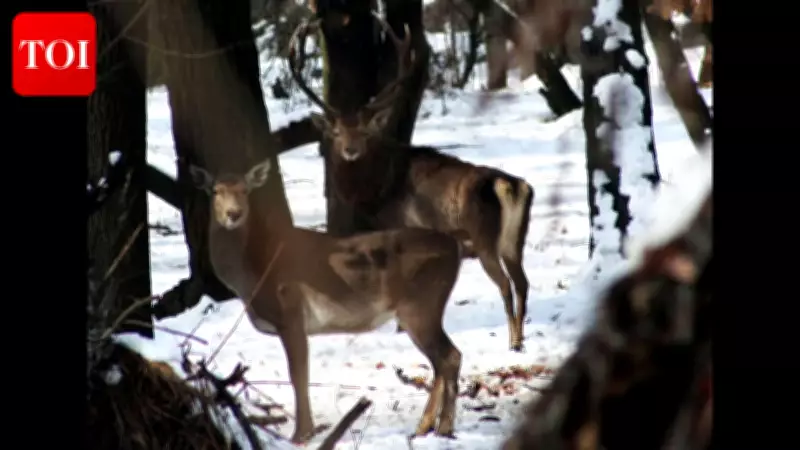
The hangul, also known as the Kashmir stag, has returned to the center of public attention after Jammu and Kashmir Chief Minister Omar Abdullah held a meeting of National Conference legislators and MPs inside Dachigam National Park on June 3. The political event, which concluded with a plan for a statehood protest march, inadvertently highlighted the precarious situation of the endangered deer. The hangul's population was estimated at 323 in the 2025 survey conducted in Dachigam and adjoining areas, a significant recovery from the low of 127 recorded in 2008. However, researchers caution that the species remains vulnerable despite the slow increase in numbers over the past two decades.
Political Debate Brings Focus to Hangul
The meeting, convened to discuss the National Conference's demand for the restoration of statehood to Jammu and Kashmir, quickly sparked a debate about the hangul's survival. Peoples Democratic Party leader Iltija Mufti remarked on social media that in Kashmir, MLAs are more endangered than hanguls, suggesting a separate wildlife park for legislators. National Conference lawmaker Sajjad Shaheen responded sharply, noting that elected representatives meet people daily and can hardly be described as endangered. This political exchange brought the species into the spotlight, with researchers emphasizing that the hangul remains vulnerable despite a slow rise in numbers over the past two decades.
Historical Decline and Recent Recovery
The hangul's decline has been severe over the last century. Historical estimates place the population at around 5,000 in 1900 and about 2,000 by 1947, though precise figures from that period are unavailable. Wildlife Protection Department surveys show the scale of the slide in recent decades: 197 animals were estimated in 2004, followed by 153 in 2006 and 127 in 2008. Numbers then rose to 175 in 2009, 218 in 2011, 183 in 2015, 214 in 2017, 237 in 2019, 261 in 2021, 275 in 2023, and 323 in the 2025 survey based on direct sightings.

Threats to the Hangul's Survival
Despite the improvement, researchers warn that the species still survives in a small, fragmented population with limited genetic diversity and a habitat that has shrunk under sustained pressure. They caution that the hangul risks being trapped in an extinction vortex, where a small population, low genetic diversity, and disconnected habitats make breeding weaker and recovery harder, even when census numbers show a gradual rise.
A Jammu and Kashmir wildlife department report last year flagged significant degradation of hangul habitat due to extensive biotic disturbances. These include excessive livestock grazing in former summer ranges, grass cutting, collection of fuel and firewood, and human movement, particularly from CRPF personnel and vehicles stationed inside the park and staff of more than six other government departments operating in Lower Dachigam. The report also noted that poaching has played a major role in the deterioration of hangul habitat and contributed to the species' decline.
Conservation Measures Needed
Researchers emphasize that immediate conservation measures are necessary for the hangul. These include removal of livestock from key habitats, recovery of productive summer ranges, protection of wildlife corridors connecting Dachigam with other parts of the species' historic range, and control of feral dogs that prey on fawns and compete with wildlife. One researcher stated, We have evidence that where there are hangul, there are also dogs. An increase in the dog population impacts the hangul population and needs to be checked.
However, Parvaiz Ahmad Wani, wildlife warden, said the department has no recorded history of dogs being sighted inside Dachigam National Park. We have not recorded any such incident so far. I don't think there are feral dogs or stray dogs inside the park. Even if a dog enters the park, it is unlikely to survive for long as predators like leopards are present there. A dog is easy prey for a leopard and would be preferred over many other animals, Wani said.
Wani noted that the park's peripheral areas have undergone significant conservation measures over the years, and a sheep breeding farm has been relocated from the park. He suggested that eco-tourism could be promoted in Dachigam, provided it is regulated and planned around conservation.

Recommendations for Hangul Conservation
A researcher from Sher-e-Kashmir University of Agricultural Sciences and Technology said recommendations for hangul conservation have already been submitted to the chief minister, including legal protection for movement corridors identified through satellite telemetry studies. Maintaining connectivity is critical for ensuring gene flow. Through satellite telemetry studies, we have identified the areas used by hangul for movement and recommended that these corridors be brought under legal protection, the researcher said.
Researchers also favor regulated hangul-focused eco-tourism, provided it is planned around conservation and does not add pressure to the animal's habitat. If people come to see the hangul, it will promote eco-tourism and create a stronger connection between local communities and wildlife, a researcher said, adding that greater visitor presence in forest areas could improve monitoring and surveillance, deter illegal activity, support conservation efforts, and help stop poaching.
Conclusion
The political demand discussed in Dachigam will be decided by the central government, but researchers emphasize that the measures needed to secure the hangul's future—protecting corridors, reducing disturbance, removing livestock from sensitive areas, and giving legal status to movement routes—remain within the authority of the Jammu and Kashmir government. For them, the June 3 meeting mattered less because of where lawmakers gathered than because it placed the region's elected leadership inside the habitat of an animal whose recovery still depends on decisions that have not yet been fully carried out.