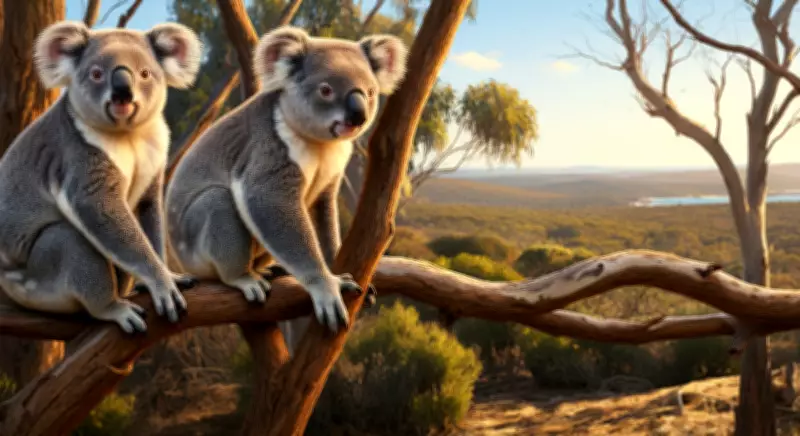
In the 1920s, conservationists relocated just 18 koalas to South Australia's Kangaroo Island, aiming to protect the species from rampant hunting and habitat loss on the mainland. A century later, that small group has multiplied into over 27,000 individuals, transforming a conservation success into an ecological crisis. Free from predators and diseases, the marsupials have bred uncontrollably, stripping eucalyptus canopies faster than the trees can regenerate. Scientists now caution that the very success of this population could trigger a catastrophic collapse, mirroring starvation events already observed on mainland Australia. New genomic research adds another layer of concern, revealing that despite their numbers, Kangaroo Island's koalas possess dangerously low genetic diversity, leaving them susceptible to disease, climate change, and future environmental shocks.
From 18 to 27,000 koalas: An explosion of numbers
Kangaroo Island, located off the coast of South Australia, had no native koalas until the 1920s. To safeguard the species from widespread fur hunting and disease outbreaks devastating mainland colonies, wildlife officials moved a small founder group, fewer than 20 animals, from Victoria into the island's protected Flinders Chase reserve. Without dingoes, foxes, or competing herbivores, the koalas flourished. A peer-reviewed assessment of the koala management program on Kangaroo Island tracked an explosive increase from that original founder group to an estimated 27,000 individuals within roughly eight decades. The same researchers noted that selective browsing, particularly on rough-barked manna gum, had already begun degrading riparian habitats well before the population reached its peak, setting the stage for today's escalating food crisis.
Eucalyptus browsing pressure and the risk of mass starvation
Koalas are obligate eucalyptus feeders, consuming up to a kilogram of leaves nightly from a narrow range of preferred species. When population density climbs faster than canopy regrowth, browsing pressure outstrips supply. A 2026 assessment published in Ecology and Evolution modeled koala densities across South Australia's protected woodlands and found numbers in several areas already exceeding what state authorities consider ecologically sustainable. The study's authors warned that if growth trends continue unchecked, populations could expand by another 17 to 25 percent over the next 25 years, intensifying defoliation in habitats with limited capacity to recover. While the modeling focused on the Mount Lofty Ranges rather than Kangaroo Island specifically, the underlying dynamic—dense, predator-free koala populations consuming eucalyptus faster than trees can regenerate—mirrors exactly what is unfolding on the island.

Cape Otway's collapse: A warning from Victoria's manna gum woodlands
This is not a hypothetical scenario. At Cape Otway in Victoria, researchers documented a near-identical sequence of events between 2011 and 2013. As koala density nearly doubled, manna gum canopy condition collapsed, with 71 percent of trees recorded as completely or highly defoliated by September 2013. A study published in PLoS ONE found that radio-collared koalas refused to abandon their depleted home ranges even as food disappeared, and 71 percent of the tracked animals died of starvation or were euthanized within months, with several females abandoning dependent young in a desperate bid to survive. Scientists studying that collapse warned that similar irruptions have recurred across southern Australia since 1908, usually in island or introduced populations much like the one now straining Kangaroo Island's eucalyptus forests.

Genetic bottleneck threatens long-term survival of Kangaroo Island koalas
Compounding the food crisis is a genetic one. Whole-genome sequencing published in Molecular Ecology by Flinders University researchers revealed that Kangaroo Island's koalas, despite their large numbers, carry far less genetic diversity than mainland populations in Victoria and Queensland. The study found unusually long stretches of identical DNA inherited from both parents, a hallmark of inbreeding traced back to the tiny founder population of the 1920s. Lead researcher Dr. Katie Gates noted that while the island represents a population success story in numerical terms, its genetic health tells a starkly different story, leaving koalas poorly equipped to cope with disease outbreaks or climate-driven stress. The authors recommended genetic rescue—introducing new individuals from genetically diverse mainland stock—to stop the island's koala refuge from becoming a long-term evolutionary trap.
Sterilization, translocation, and the fight to manage koala numbers
Authorities have resisted calls to cull, citing the koala's status as a tourism icon and the public backlash any mass shooting would invite. Instead, since 1997, wildlife managers have run a sterilization and translocation program, detailed in the same Kangaroo Island koala management assessment, under which roughly 6,000 koalas have been surgically sterilized and around 2,700 relocated to suitable habitat on the mainland. The approach has slowed population growth without resorting to lethal control, but it remains costly and only partially addresses underlying browsing pressure. With eucalyptus canopies already showing signs of stress, scientists say a combination of fertility control, habitat restoration, and genetic management will be essential if Kangaroo Island's koalas are to avoid repeating the starvation collapse already witnessed on the Australian mainland.