

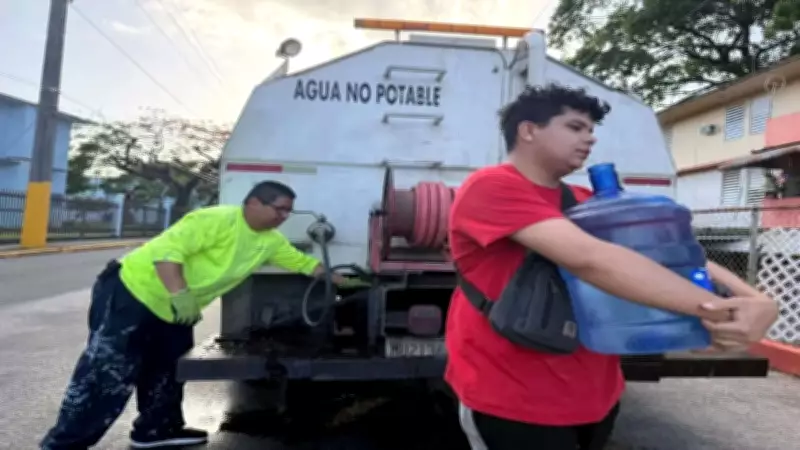
Thousands of Puerto Ricans are grappling with severe water shortages, forcing the governor of the U.S. territory to activate the National Guard as emergency responders handle daily calls.
Cause of shortages unclear
Officials have not publicly identified the cause, with outages mainly affecting parts of the island's most populated cities, including the capital, San Juan. The island's utility company draws water from rivers, reservoirs, and underground aquifers that historically supplied sufficient water for the 3.2 million residents.
Residents are compelled to buy drinking water, spend money at laundromats, and carry heavy buckets up multiple flights of stairs for washing dishes, flushing toilets, and bathing.

The elderly and disabled are hit hardest, with community leaders reporting hospitalizations due to the persistent shortages.
Jorge Figueroa, a community leader for several impoverished San Juan neighborhoods, recently stood by his car fielding questions from residents wondering when the next water truck would arrive.
"They are playing with people's health and lives," Figueroa said.
Shortages widespread
Some San Juan customers began reporting intermittent service over a year ago. The governor acknowledged that the infrastructure has lacked investment and maintenance for decades. The outages have become so severe that Mayor Miguel Romero sued Puerto Rico's Water and Sewer Authority in late May.
Residents like Jeannette Mercado Rodriguez have gone up to two weeks without water as Puerto Rico's scorching summer begins, with meteorologists issuing heat advisories.
"This is really exhausting; it's maddening," she said.
The 52-year-old is among the fortunate: a water truck is stationed near her public housing complex, Las Margaritas. Still, she must haul five buckets and ten 2-liter bottles up to her third-floor apartment daily. She recently injured her shoulder doing so.
"We can't take it sometimes," Mercado said, admitting she has broken down and cried. "There are older people here, bedridden people."
Nearly 40,000 customers faced water outages on the first weekend of June. This prompted Governor Jenniffer Gonzalez to activate the National Guard, which began distributing water via four trucks, each with a capacity of 7,570 liters.
Puerto Rico's Tourism Company brought in additional water trucks with a capacity of 48,453 liters to serve hotels and short-term rentals.
The need for water is so acute that Puerto Rico's Department of Agriculture sanitized two large milk transport trucks to deliver potable water.
Despite these measures, water remains scarce for many in San Juan and beyond. At least one stationary tanker in an impoverished community sat empty for days, with residents cheering the water truck upon its arrival and calling municipal workers "heroes." Others complain that the government does not inform them when a water truck will arrive, leaving those at work without access.
"This has been a disaster," said Luz Laborde, president of a neighborhood association in Santurce, a working-class community in San Juan. "This is inhuman ... It's destroying the emotional state of a people."
Puerto Ricans demand water
Dozens of Puerto Ricans, young and old, crowded into a courtroom recently, eager to hear a ruling on the lawsuit filed by San Juan's mayor against the island's water and sewer company, questioning when their water would return.
"We are exhausted," said Marcia Soler Paris, a 61-year-old community leader. "We shouldn't be living this way. We don't deserve this."
Every day at dawn, phones ping as people in San Juan and elsewhere share whether they have water, just a trickle, or nothing at all.
Soler calls the emergency management office every other day to request a water truck for herself and her neighbors. She lives with her daughter and three grandsons, aged 13, 10, and 4, who play soccer daily. Like many, they lack a cistern.
"I don't know what it is to see a stream of water," said Soler, who recently spent $40 at a laundromat and was forced to buy plastic cups and plates for her family.
The extra costs strain budgets on an island where over 40% of the 3.2 million people live below the poverty line.

Soler noted that some of her bedridden neighbors rely on caregivers using towels and wet wipes for cleaning. Another neighbor is blind, so people ferry water up to her apartment.
For years, chronic power outages have frustrated many Puerto Ricans. Now, water woes also top the list.
At Villa Kennedy, a nearby public housing complex, Elizabeth Sanchez, 79, explained how she injured her waist carrying buckets of water. Her husband can no longer help due to a back injury from the same cause.
"What we are going through is horrible," she said, crying.
Judge orders experts to investigate water woes
In February 2025, Puerto Rico's governor appointed Luis Gonzalez Delgado as executive president of the island's Water and Sewer Authority.
Months later, former regional director Roberto Martinez Toledo was replaced. However, Martinez was recently appointed to a new committee ordered by a judge to work with the agency to investigate and resolve the chronic water shortages.
San Juan's mayor, a member of the governor's party, stated that if Martinez had not been removed, "we wouldn't be here talking about this issue."
The new head of the water and sewer agency blamed Martinez for some problems.
"(The crisis) could have been avoided if Roberto Martinez had answered the phone the first day I called him," Gonzalez told reporters this week, adding that he is willing to work with him.
Some Puerto Ricans demand Gonzalez's resignation while clamoring for Martinez's return to his old job, with a growing number blaming the governor for the situation. On Wednesday night, the governor announced that all projects aimed at fixing water-related infrastructure have started, with an investment of $217 million.
Those without water say they are still being billed for it.
"That's another outrage," said Laborde. "You lose no matter what."





