

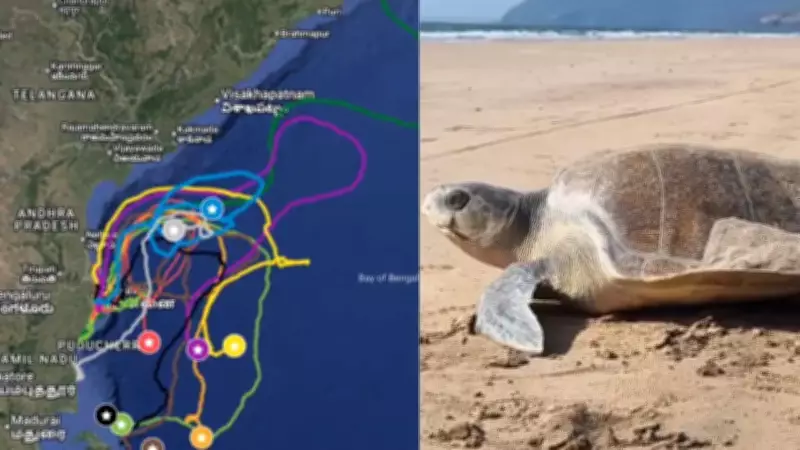
Olive Ridley turtles released into the ocean near Chennai are being monitored as they migrate toward the Sri Lanka Dome, a highly fertile marine area in the Indian Ocean. Findings from a satellite telemetry experiment, launched in January 2026, have revealed these migratory paths. The project involves tagging two Olive Ridley turtles and releasing them, conducted jointly by the Wildlife Institute of India. Initial data indicates definite routes toward nutrient-rich zones that support high concentrations of marine organisms. Officials from Tamil Nadu’s Environment, Climate Change, and Forests Department noted that the study will provide valuable insights into Olive Ridley turtle behavior.
Olive Ridley Turtles Move Toward Sri Lanka Dome Seasonal Feeding Zone in 2026
According to a post on X (formerly Twitter) by Additional Chief Secretary Supriya Sahu, both tagged turtles have been tracked moving to the Sri Lanka Dome, an ocean seasonality feature in the Indian Ocean. This area is characterized by strong upwelling that brings nutrient-rich water to the surface, promoting plankton growth. Plankton attract fish, birds, whales, and turtles. The Sri Lanka Dome is one of the region’s most productive areas. The migration path of both turtles aligns with this natural phenomenon, which becomes active in May, peaks in July, and declines by September. The tagged turtles appear to follow their natural feeding period, illustrating long-distance travel through international waters.
Sri Lanka Dome Forms a Seasonal Feeding Hotspot for Olive Ridley Turtles
The Sri Lanka Dome is not a permanent feature; it forms due to seasonal wind patterns and ocean circulation. When conditions are right, cooler waters rise from deeper layers, carrying nutrients upward, creating dense feeding grounds. Marine species gather quickly, making the region a temporary hotspot in the Indian Ocean. Data from the tagged turtles suggests that Olive Ridleys actively use these zones during post-nesting migration. Their movement patterns show repeated use of productive feeding areas rather than random dispersal. Scientists involved say the findings confirm long-standing assumptions about how ocean productivity influences turtle migration. The recorded routes also show how sensitive these animals are to changes in marine conditions.

What Satellite Tagging of Olive Ridley Turtles off Chennai Coast Shows
The study began with tagging two Olive Ridley turtles off the Chennai coast in January 2026. The objective is to track their movements, nesting activities, and engagement with fishing areas. The Wildlife Institute of India conducts the study with state government officials. The tag tracks the animal’s location in near real-time, providing concrete proof of the distance covered after nesting along Tamil Nadu’s coast. Initial findings show that turtles stay close to coastal waters for a period before heading to the open ocean.
Odisha and Tamil Nadu Olive Ridley Turtles Meet in Same Marine Feeding Zone
Authorities indicated that Olive Ridley turtles migrating from Odisha are expected to reach the same region, as per the X post. This suggests a shared feeding ground used by populations from different nesting sites along India’s eastern coast. Such convergence points to connected marine pathways across the Bay of Bengal and adjoining waters. The tracking study is expected to continue through multiple migration cycles. Researchers plan to observe whether the same individuals return to the same nesting beaches in Tamil Nadu after completing their oceanic movement.
Olive Ridley Turtles Highlight Need to Protect Tamil Nadu Nesting Beaches
The findings underscore the importance of protecting nesting beaches along Tamil Nadu’s coastline. Early observations suggest turtles return repeatedly to the same shores during breeding cycles. Fishing activity and coastal disturbance remain key concerns for conservation teams. Monitoring data is expected to help identify areas where human activity overlaps with migration routes. The study is still in its early phase but is already providing measurable migration maps not previously available. Further tagging may expand the dataset and improve understanding of long-distance marine behavior.






