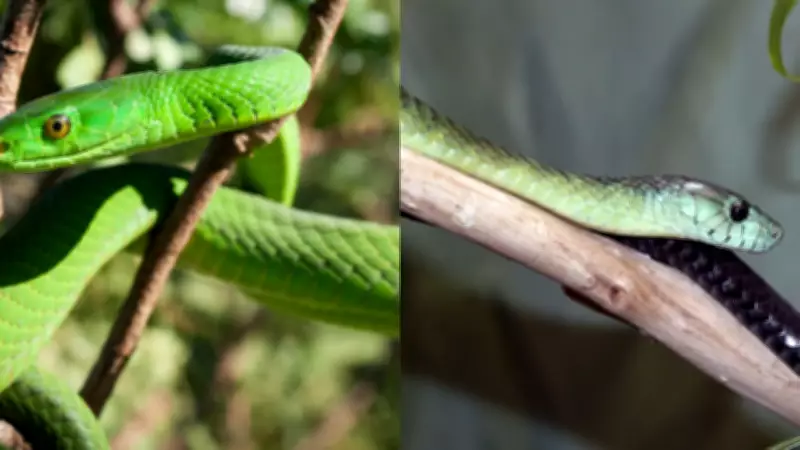
South Africa is home to several striking green snake species, yet colour alone is one of the least reliable ways to identify them. Every year, harmless green snakes are killed because they are mistaken for highly venomous species such as the Green Mamba or Boomslang. According to the South African Association for Marine Biological Research (SAAMBR), six green snakes are commonly encountered across the country, ranging from small bush-dwelling species to some of Africa's most recognisable arboreal predators. While only two of these snakes are considered medically significant, confusion remains widespread among homeowners, hikers and gardeners. Understanding the differences in body shape, eye colour, habitat and distribution can help prevent unnecessary fear while supporting conservation efforts. Here is a closer look at South Africa's six most commonly encountered green snakes and how to tell them apart.
Most Green Snakes Are Harmless
Of the six commonly encountered green snakes, only the Green Mamba and Boomslang are highly venomous. The remaining four species pose no medically significant threat to humans.
Green Mamba (Dendroaspis angusticeps)
Among South Africa's most famous snakes, the Green Mamba is also one of the most misunderstood. They are found anywhere from the Eastern Cape/KwaZulu-Natal border extending north-east into Mozambique, Tanzania and Kenya, and inland to eastern Zimbabwe and Malawi. This highly venomous species inhabits coastal forests and dense vegetation along parts of KwaZulu-Natal's coastline. It is generally shy, spends most of its life in trees and prefers avoiding human contact. According to the Biodiversity & Environment Africa, the Green Mamba spends most of its life in dense coastal vegetation and moist woodlands where it hunts for tree-living mammals as well as birds during the day. Green Mambas can exceed 2.5 metres in length and possess a distinctive, elongated, coffin-shaped head. Their bright green colour often leads to confusion with harmless bush snakes, although their larger size and restricted coastal distribution provide important clues.

Boomslang (Dispholidus typus)
The Boomslang is another highly venomous green snake found across much of South Africa, except in the driest western regions. Adult males are commonly bright green, while females are often olive-brown. According to Animal Diversity Web, one of its most distinctive features is its exceptionally large eye relative to the head. The species can reach around 1.2-1.5 metres and possesses a potent haemotoxic venom requiring specialised antivenom. Despite this, experts describe the Boomslang as remarkably docile and reluctant to bite unless handled or threatened. Boomslangs are solitary reptiles that rarely communicate with, and will even prey upon, other members of their species. They spend most of their day hunting in trees and shrubs, carefully gliding through tree branches until an ideal hiding place is found. Boomslangs strike without warning and are able to capture most of their prey without being seen. Juveniles are rarely green and instead appear greyish with yellow or orange throats, making them easier to distinguish from other green species.
Eastern Natal Green Snake (Philothamnus natalensis natalensis)
The Eastern Natal Green Snake is a harmless arboreal species occurring mainly along the KwaZulu-Natal coast and extending into north-eastern South Africa. It is usually a bright, uniform green with a characteristic yellow iris. As stated by the Wildlife Vagabond, although non-venomous, it is an active and agile climber. Researchers note that it grows to an average length of 90 cm (2 ft 11 in), and some reach up to 130 cm (4 ft 3 in). It is a uniform bright green to turquoise green snake, with a pale green to yellowish belly. Juveniles may have some black markings towards the front. It can be confused with other green snakes in the Philothamnus genus. When threatened, the species may inflate its neck, a defensive display that often causes observers to mistake it for a more dangerous snake.

Western Natal Green Snake (Philothamnus natalensis occidentalis)
As Project Noah states, closely related to its eastern counterpart, the Western Natal Green Snake ranges further inland and southwards, extending into parts of the Western Cape. It is typically more turquoise-green, particularly around the head and tail. Unlike the Eastern Natal Green Snake, it usually possesses darker eyes and often occurs near rivers, streams and well-wooded habitats. Individuals may exceed one metre in length but remain slender and harmless. When disturbed, it may expand its throat to reveal bluish or turquoise skin between the scales, creating a dramatic but harmless warning display.
Green Water Snake (Philothamnus hoplogaster)
The Green Water Snake is commonly found throughout eastern South Africa and further north across the continent. As its name suggests, it is closely associated with wetlands, rivers and other aquatic habitats. According to Maritzlab, of the true green snakes, the southeastern green snake, sometimes referred to as the green water snake, is the least arboreal and may be seen swimming or even eating a fish, although their diet consists mostly of grass frogs and river frogs. The remaining two green snakes are similar to each other, and researchers concluded only recently that they are distinct species. This species is generally shorter and more robust than Natal Green Snakes, averaging about 50 centimetres in length. It typically has a pale lower jaw, yellow markings around the eye and a rounded head shape. Although harmless to humans, it is a skilled hunter of frogs, fish and aquatic prey. Its association with water is often one of the easiest identification clues.
Spotted Bush Snake (Philothamnus semivariegatus)
As recorded by Wildlife Vagabond, the Spotted Bush Snake is arguably the most frequently encountered green snake in southern Africa. It occupies a vast range and is often seen in gardens, shrubs and around houses where it hunts geckos and lizards. Its most reliable identifying feature is the presence of dark spots or crossbars along the front half of the body. Many individuals also possess striking yellow, orange or reddish irises. Snake experts note that this harmless species is regularly mistaken for Green Mambas, particularly in urban areas where genuine mambas rarely occur.