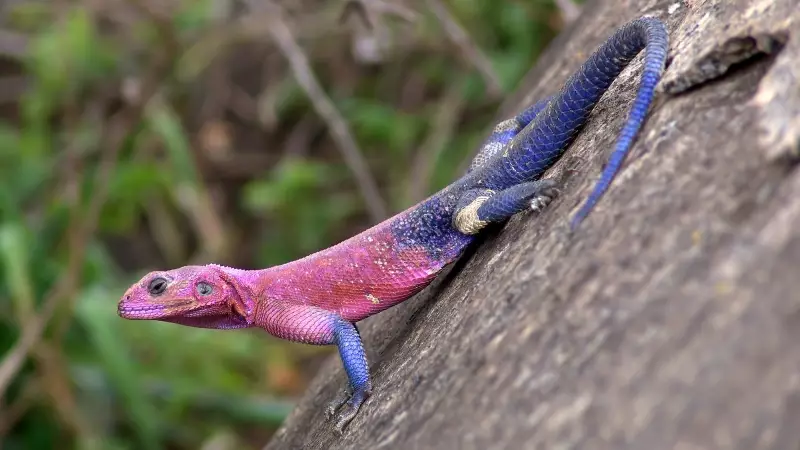
If you've ever scrolled through social media and spotted a lizard that looks like it leaped straight out of a Marvel comic book, your eyes weren't deceiving you. You've likely encountered the Mwanza flat-headed rock agama (Agama mwanzae), a remarkable reptile that has captured global attention as nature's real-life Spider-Man.
The Viral Spider-Man Lizard: Appearance and Habitat
With its striking crimson red head and upper body dramatically contrasted against a deep blue lower body and tail, this East African native has earned the nickname "the Spider-Man lizard" for its uncanny resemblance to the popular superhero's costume. The vibrant creature typically measures about 25-30 centimetres in length, making it a medium-sized lizard that's hard to miss against its rocky surroundings.
This colourful reptile is native to East Africa, predominantly found in Tanzania, Kenya, and Rwanda. It thrives in semi-arid regions characterized by abundant rocky terrain and sparse vegetation. These rocks aren't merely decorative elements in their environment—they're fundamental to the agama's survival strategy.

The Mwanza flat-headed rock agama spends most of its daylight hours basking on sun-warmed stones, absorbing heat to regulate its body temperature. At the slightest hint of danger, it demonstrates incredible agility, darting quickly into rock crevices for protection. Its flattened head and nimble limbs are evolutionary adaptations that allow it to slip effortlessly into narrow cracks, serving both as protective shelters and perfect vantage points for hunting prey.
Diet and Hunting Behaviour
The agama's diet consists primarily of insects, with a particular preference for ants, beetles, and termites. Occasionally, it supplements its insect-based diet with small vertebrates or plant material, demonstrating opportunistic feeding behaviour.
What makes this lizard an exceptional hunter are its sharp reflexes and impressive bursts of speed. It can capture prey mid-crawl with remarkable precision, often ambushing insects from its rocky perch. Its hunting strategy combines patience with lightning-fast strikes, making it a formidable predator in its ecosystem.
Gender Differences and Mating Rituals
One of the most fascinating aspects of this species is that only dominant males display the vivid red-and-blue colouring that has made them internet famous. This brilliant coloration results from territorial and mating displays rather than being a constant feature. Females and subordinate males typically exhibit dull brown or grey coloration, providing them with better camouflage against predators and rocky backgrounds.
During courtship rituals, a dominant male performs elaborate head-bobbing and push-up motions to assert dominance and attract potential mates. These displays serve the dual purpose of intimidating rival males while showcasing the male's vibrant hues to females. The brighter and more intense the colours, the more likely the male is to successfully mate.
Adaptation and Survival Strategies
As diurnal creatures, Mwanza flat-headed rock agamas are exclusively active during daylight hours. Their flattened body shape and powerful limbs make them expert climbers, often seen scaling vertical rock surfaces or basking atop prominent stones under the intense African sun.
Despite their bold and conspicuous appearance (in the case of dominant males), these lizards are surprisingly shy and quick to flee when approached by potential threats. This combination of vibrant display for mating purposes and cautious behaviour for survival represents an evolutionary balancing act that has served the species well.
The Mwanza flat-headed rock agama stands as a compelling example of evolutionary adaptation, successfully thriving in harsh, arid environments while managing the competing demands of camouflage, display, and survival. These remarkable creatures remind us that even in the most challenging habitats, nature produces extraordinary colours and adaptations that continue to capture human imagination and fascination.