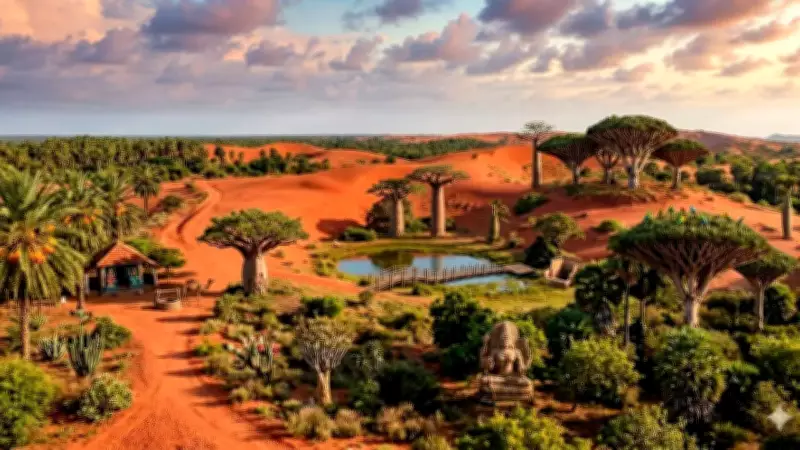
Theri Kaadu's striking landscape is not just a trick of the light; those vibrant red dunes, known locally as teri sands, are a geological marvel. Walking across them feels like stepping onto the surface of Mars, with the rusted earth providing a sharp, beautiful contrast against the bright blue of the Laccadive Sea. This is the scene from Theri Kaadu, the mesmerising red-sand desert of Tamil Nadu. Far from being a typical wasteland, this 'Red Dune forest' is a scientifically significant landscape that acts as a rare window into our planet's past. The intense crimson hue is the result of centuries of iron oxidation, where heavy minerals like ilmenite and garnet have weathered to create a distinct, rusted pigment. Driven by the relentless southwest monsoon winds, these dunes are a living, breathing Pleistocene relic, supporting a unique ecosystem of hardy palmyra palms and thorny scrub that somehow thrive in the mineral-rich grit. It is a place where nature's ancient chemistry and modern beauty collide, offering a surreal experience that feels both prehistoric and otherworldly.
The Mystery of Tamil Nadu's Red Dune Forest
According to research published in Research Gate, titled 'Chronology and weathering history of red dunes (Teri Sands) in the southwest coast of Tamil Nadu, India', these formations date back to the Quaternary Period, with their iconic crimson pigment caused by iron oxide (haematite) coating the quartz grains over millennia. Referring to the research published on Research Gate, titled 'Teri Red Sands, Tamil Nadu', experts highlight that this ecosystem is not merely a visual marvel but a mineralogical treasure trove. It is a place where the wind whispers through Red Dune forests, inviting anyone off the beaten track to see a side of Tamil Nadu that defies expectation. Even for those who know the coast, these sands offer a sudden shift, trading tropical greens for a world of deep, dusty crimson. These ancient Teri sands are a crimson masterpiece carved by time and tide, where the earth has been stained a deep, rusted orange by minerals oxidised over millennia. It is a surreal coastal pocket where the vibrant ground meets the sea, proving that nature is often the most imaginative artist of all.
The Unique Biodiversity of the Red Dune Forest
The Red Dune Forest of Theri Kaadu is far more than a geological curiosity. It is a living and breathing ecosystem where life has learned to thrive in a harsh environment. In the forest, hardy palmyra palms and cashew trees anchor the shifting crimson sands, creating a resilient sanctuary in the heat. It is a reminder that even in the most demanding conditions, nature always finds a way to take root and flourish. According to the study, this flora is supported by a remarkable hydrological phenomenon known as the 'sunai'. These are natural freshwater springs that emerge through the porous, iron-rich sands, acting as a lifeline for both plants and animals.

The Inland and Coastal Divide: Why Theri Kaadu Is a Double Wonder
As reported, the landscape is split between ancient inland deposits and much younger coastal formations. While the inland dunes are weathered relics of a distant past, the coastal 'near-shore' theris are dynamic, wind-sculpted features that continue to shift today, making this an offbeat southern destination. Closer to the waves, the coastal theris take a different approach entirely. As per the study published in Research Gate, titled 'Recovery of Ilmenite and Other Heavy Minerals from Teri Sands (Red Sands) of Tamil Nadu, India', these 'near-coast' sands are an aeolian masterpiece, constantly being reshaped by relentless southwest winds. These dunes are mineralogical powerhouses, packed with zircon, rutile, and garnet. This restless, wind-carved landscape shifts against the ancient interior, ensuring every step through the red desert reveals a new chapter in the Earth's history.

A Scarlet Signature: Decoding the 15,000-Year History of Theri Kaadu
The red sand desert is not a static relic but a living chronicle of environmental change. As per the study, the vivid colour that serves as the region's 'scarlet signature' is a result of thousands of years of iron oxidation. Every grain of sand, coated in haematite, tells a story of ancient monsoons and tropical heat that have magically 'painted' this beauty. Theri Kaadu reminds us that the most remarkable things are often right before our eyes, just waiting to be discovered. It is a place where time itself has been carved into the earth, inviting us to witness a work of art that has been fifteen thousand years in the making.