

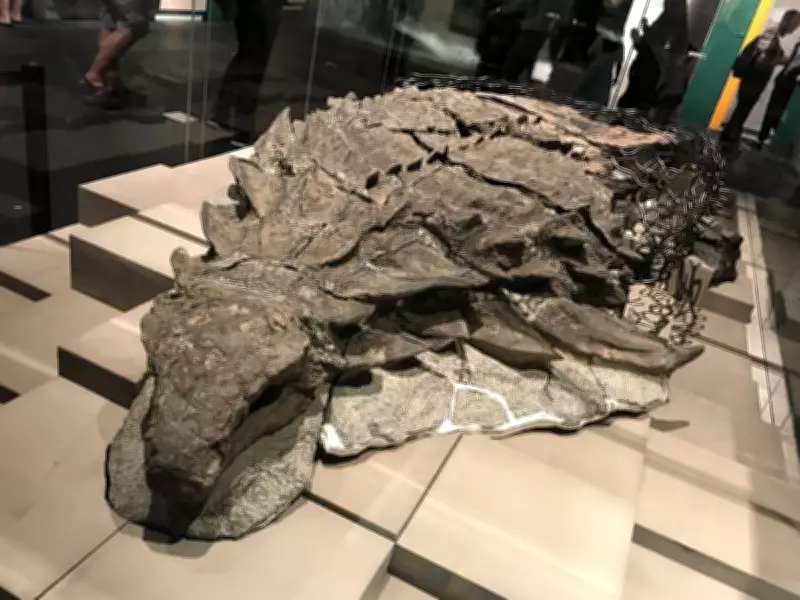
On a morning in March 2011, what seemed like an ordinary day at an oil sands mining facility in northern Alberta, Canada, turned into an extraordinary paleontological find. An operator driving heavy equipment at Suncor's Millennium Mine encountered what he thought was a very hard section of rock. Instead, he uncovered something far more fascinating: the fossilized remains of an armored dinosaur buried for about 110 million years.
The Accidental Discovery
The fossil turned out to be Borealopelta markmitchelli, a herbivorous nodosaur from the Early Cretaceous period. Unlike many celebrated finds, this specimen was not excavated in a planned dig. Heavy equipment operator Shawn Funk accidentally uncovered the fossil during mining operations at the Millennium Mine near Fort McMurray, Alberta. The fossil was transported to the Royal Tyrrell Museum of Paleontology, where technician Mark Mitchell spent over 7,000 hours meticulously extracting the bones from the encasing rock. This labor was so valuable that researchers named the species in his honor. The genus name Borealopelta means 'northern shield', while the species name markmitchelli honors Mitchell for his extensive preparation work.
Exceptional Preservation
What set this fossil apart was its extraordinary state of preservation. Large areas of the skin covering and keratin armor survived fossilization, with much of the armor still intact in its original positions. The preservation was so striking that several researchers described it as one of the best-preserved dinosaur fossils of its size ever found. A 2017 report by National Geographic noted that the fossil preserved the dinosaur in its three-dimensional form, a rarity among fossils. The specimen measures approximately 5.5 meters long and is believed to have weighed over 1,300 kilograms when alive.

Burial Beneath an Ancient Sea
Additional research provided explanations for such unusual preservation. According to a 2020 paper, the fossil was recovered from marine sediments of the Wabiskaw Member of the Clearwater Formation in Alberta. This suggests the dinosaur did not perish where it was found. It is believed that the carcass entered a marine environment before burial, and the sediment prevented the breakdown of organic tissues. Though Borealopelta was a terrestrial creature, it ended up preserved under ocean-deposited sediments, a factor contributing to its perfect condition.
Insights into Cretaceous Life
Due to the degree of preservation, researchers explored characteristics not usually seen in fossils. From the 2020 study of stomach contents, scientists detected remnants of its last meals, indicating the herbivorous dinosaur had recently eaten ferns and other plants before death. Analysis of body armor arrangement and structure has helped researchers understand how nodosaurs might have looked and functioned.
Enduring Significance
Discovered over a decade ago, Borealopelta markmitchelli remains relevant due to the unlikely circumstances of its recovery. It is unique because it was accidentally found in a mining operation, not by scientists, and is one of the most well-preserved armored dinosaurs ever studied. Its discovery has provided an unusually detailed record of an animal from the Early Cretaceous, around 110 million years ago. This accidental find during mining operations ultimately revealed one of the most remarkable dinosaur fossils ever uncovered.






