

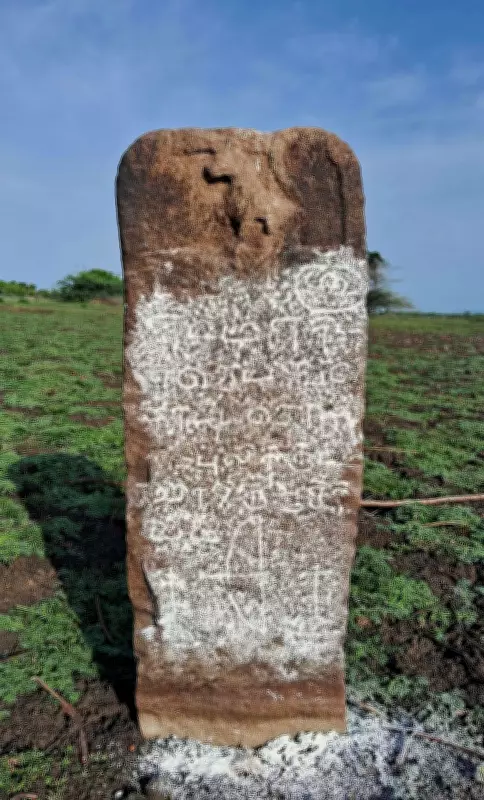
Archaeologists have identified a rare 13th-century inscription in Sivaganga district that records a tiger-related incident involving a warrior and a merchant. This discovery offers valuable insights into trade, protection, and social support practices in medieval Tamil society.
Discovery of the Inscription
The inscription was found at Cholapuram near Sivaganga after local resident Balasundaram informed archaeologists about an unusual stone located in the Etticheri tank. A field study was subsequently conducted by K. Kaaliraja.
Uncommon 'Aasiriyam' Category
According to Kaaliraja, the inscription belongs to the uncommon “Aasiriyam” category, which is associated with protection, assistance, and support rather than land grants or temple endowments commonly found in medieval inscriptions.

Physical Description
The stone stands about three feet tall and 1.25 feet wide and is located near a sluice pillar in the inner section of the tank. A carved tiger with one raised leg appears at the top of the inscription. The text begins with the phrase “Swasthi Sri” and concludes with engravings of a bow and arrow flanked by two traditional lamps.
Content of the Inscription
The inscription records that a person named Eriyan, who held the title “Etti” associated with merchants, granted an Aasiriyam to a warrior identified as Pulikkutti Veeran. The Sivagangai Archaeology Group, a local team comprising archaeological experts and amateurs, said the word “Etti” was a title conferred on merchants and is referenced in the ancient Tamil epic Silappatikaram.
The group’s secretary, R. Narasimman, said, “The inscription informs us that Eriyan, bearing the merchant title ‘Etti’, granted an Aasiriyam to a warrior who killed a tiger in Seyangonda Cholapuram.” Kaaliraja added that the warrior may have been part of a merchant caravan and fought the animal while protecting traders travelling through the region.
Possible Sacrifice
Kaaliraja also said that it can be inferred that the warrior who fought and killed the tiger while accompanying merchant groups may also have lost his life in the encounter. “Further, it is possible that this tank was established to provide support to his descendants. Even today, the waterbody continues to be known as Etticheri tank,” he added.
Historical Context
An earlier inscription of Maravarman Sundarapandiyan found in the village refers to the settlement as Mudikonda Cholapuram, while the newly documented inscription identifies it as Seyangonda Cholapuram. Based on the script style, researchers have dated the inscription to the 13th century.






