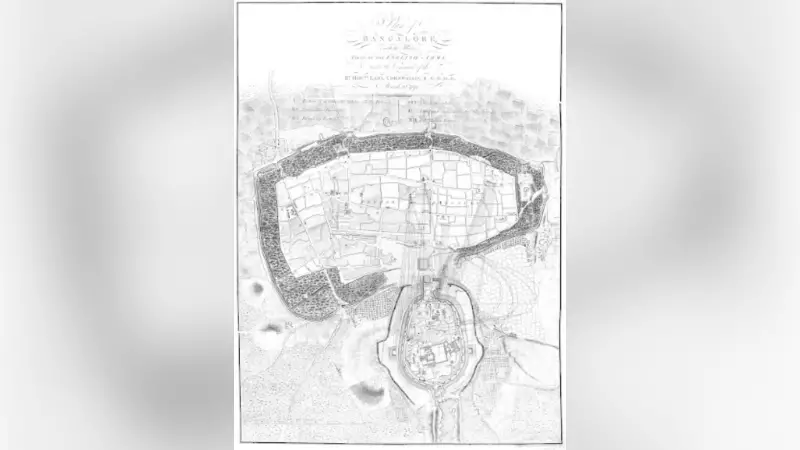
A rare first-hand account penned by a British soldier in the late 18th century provides a fascinating window into the history of Bengaluru and the military campaigns of the East India Company in Karnataka. The document, titled Sketch of the War with Tippoo Sultaun and published in 1793, was written by Roderick Mackenzie, a lieutenant in the 52nd Oxfordshire Regiment of Foot.
What Makes Mackenzie's Account Unique?
While several British officers documented the conflicts between the East India Company and Mysore under Tipu Sultan, Mackenzie's work is distinctive for two primary reasons. First, it focuses specifically on the Third Anglo-Mysore War (1790-1792), unlike many narratives centered on the final Fourth war. Second, it delivers an exceptionally detailed record of the British siege of Bangalore in 1791, offering clues about the city's landscape and significance at the time.
When studied alongside contemporary maps, like the one created by J Cooke in 1792 after Lord Cornwallis's victory, Mackenzie's descriptions help reconstruct Bangalore's strategic importance. His writings indicate that after Bangalore's fall, resistance in other strongholds like Dharwar weakened, and local polygars (feudal chieftains) began aligning with the British, anticipating their ultimate triumph.

Glimpses of 1790s Bangalore: Climate, Soil, and Society
Long before it earned the moniker 'pensioners' paradise,' Bangalore's pleasant climate was noted by Mackenzie. He described the city's "extremely temperate and salubrious" climate, attributing it to its central peninsular location and abundant water reservoirs. He praised its fruitful soil, which produced necessities in plenty, and noted how European vegetables like cabbages and lettuce thrived in gardens tended by British officers.
Beyond the environment, the text reveals colonial attitudes of the era, including stereotypical views of local communities. Yet, it also contains valuable socio-economic observations. One passage notes how "native grains" could be stored for up to five years under proper conditions—a critical detail in an era where farmers relied entirely on monsoon rains without modern agricultural technology.
The Mechanics of Colonial Warfare
Mackenzie's account is a meticulous log of how the East India Company waged war. It delves deep into military logistics, tactical decisions, and artillery operations during engagements like the Siege of Bangalore. The soldier includes precise tables outlining supplies per man, the number of bullocks required for transport, and even the fodder needed for the animals.
Such details extend to the amount of ammunition a single pack animal could carry and the tent space allotted for soldiers of different ranks. The document also covers the war's conclusion, listing the specific clauses of the treaty imposed on Tipu Sultan, which resulted in the loss of half his territory.
Despite the wealth of historical detail, Roderick Mackenzie himself remains an enigmatic figure. His book offers few personal clues, leaving his identity largely to history. For interested readers and researchers, open-access digital copies of this valuable historical document are available on platforms like the Internet Archive, preserving this unique perspective on a pivotal period in Karnataka's history.