

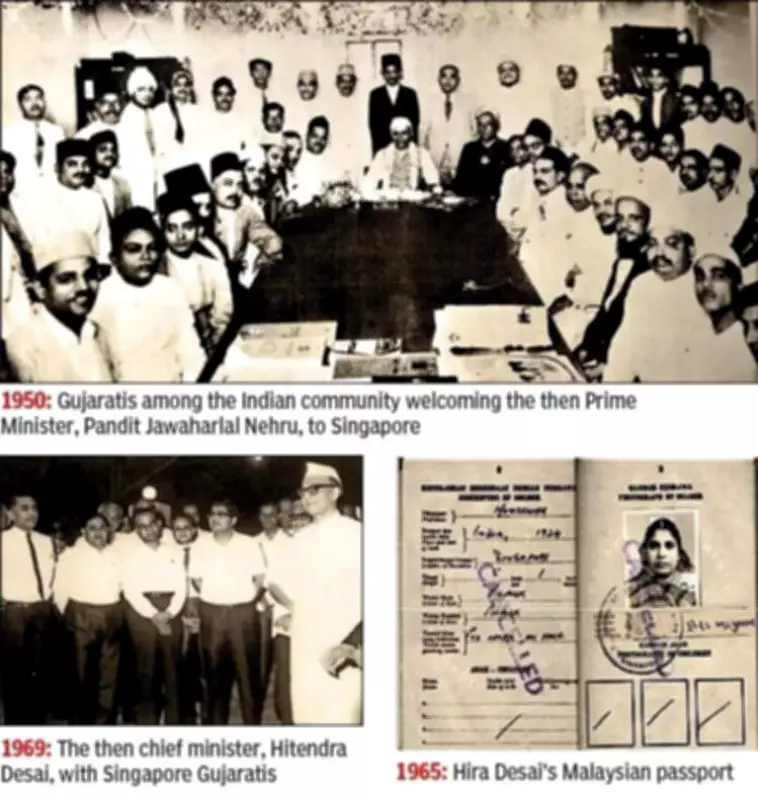
Ahmedabad: The earliest Gujarati-speaking individuals to arrive in present-day Singapore are believed to have been traders accompanying Stamford Raffles, the British official who captured Singapore from local rulers and established the city-state in 1819. Parul Trivedi-Shah, in her recently published book A Legacy in the Lion City: History of the Gujarati Community in Singapore, notes that these traders were Parsi employees of Jamsetjee Jijibhoy & Company, whose ships sailed the Maritime Silk Route.
Meticulous Chronicle of Two Centuries
The book, supported by the National Heritage Board of Singapore, meticulously documents the community's presence for over 200 years. It highlights the perseverance of early settlers who built businesses, endured the Japanese invasion of the island, and maintained their influence not only in commerce but also in art, literature, politics, public life, education, and philanthropy—deeply intertwined with Singapore's history.
Trivedi-Shah says, "I met elderly community members and gathered historic records, correspondence, and old documents to piece together the experiences of the earliest settlers. For instance, Nagardas Purshottamdas is believed to be the first known Gujarati Hindu to migrate to Singapore in the mid-1880s. His brothers Vadilal and Ojamshee joined him in 1894."

Enterprise Without Boundaries
Handwritten notes from Harakhchand Shah in 1894 describe the steamer's route from India's east coast to Penang in Malaysia and finally to Singapore, strategically located on the strait connecting the Spice Islands to international maritime trade. The history also showcases enterprise transcending religion and caste: Gujarati Sunni Muslims arrived in 1837, Dawoodi Bohras in 1860, and Banias in the 1880s. Parsis, Muslims, Hindus, and Jains made the island their hub. Today, the Gujarati community of 4,000–5,000 members exemplifies cultural vibrancy, celebrating Diwali and Navratri and actively participating in Singapore's social and political affairs.
Contributions to Singapore Society
"Singapore has seen businessman Neil Parekh and academician Professor Kalyani Mehta nominated to Parliament, along with numerous prominent doctors, businessmen, artists, and professionals gaining prominence in Singaporean society," says Trivedi-Shah. "The Singapore Gujarati Samaj serves as a hub for community and social activities, while the Singapore Gujarati School teaches the Gujarati language to children." She adds, "Gujarat is the land of lions, and Singapore is known as the Lion City. Thus, it is a unique amalgamation of beliefs and identities."
About the Author
Parth Shastri is a senior assistant editor covering Gujarat-related issues for nearly two decades, focusing on health, higher education, premier educational institutes, public health, science and technology, startups, space, and archaeology.






