

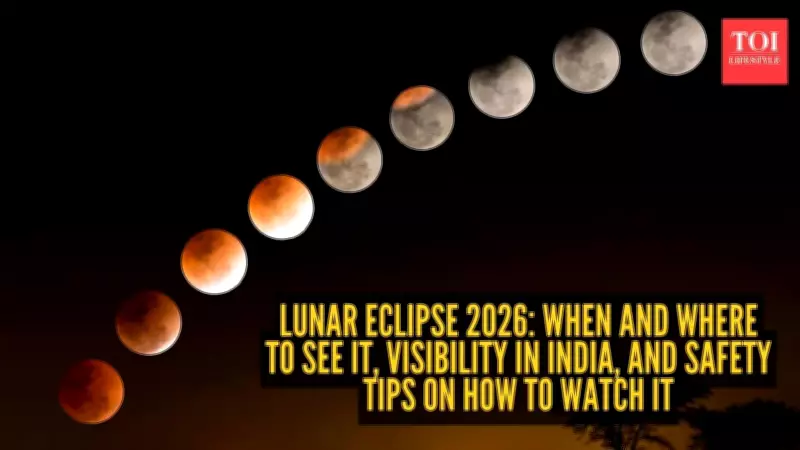
First Lunar Eclipse of 2026: A Celestial Event Over India
If you gaze upward this evening, the sky presents a quietly dramatic celestial performance. March 3, 2026, marks the arrival of the year's first lunar eclipse, traditionally known as Chandra Grahan. This event unfolds without fanfare or digital countdowns—just the Earth, Moon, and shadow engaging in their ancient cosmic dance.
Timing and Visibility Across India
Globally classified as a total lunar eclipse, what you witness depends entirely on your location. For most of India, this will not be an all-night spectacle, and you may not see every stage from the beginning. However, even a brief glimpse can feel profoundly special when you understand the celestial mechanics at play.
Chandra Grahan Timings in Indian Standard Time (IST):

- Start of penumbral phase: 4:58 PM IST
- Start of totality: 4:58 PM IST
- End of totality: 5:32 PM IST
- End of penumbral phase: 7:53 PM IST
The timings may initially appear confusing—how can totality begin simultaneously with the penumbral phase? The explanation is straightforward: by moonrise in many Indian regions, the earlier eclipse stages are already in progress. Essentially, you're entering the celestial narrative midway.
For most Indian cities, the Moon will ascend while still within Earth's shadow, meaning observers will primarily catch the final stretch as our satellite gradually emerges from shadow and regains its luminosity. The visible window in numerous areas is expected to last approximately 20 minutes around sunset, eliminating any need for midnight alarms—simply step outside at dusk.
Regional Visibility Variations
Will the full lunar eclipse be visible throughout India? The concise answer is no. In most regions, you'll only observe the concluding phase of Chandra Grahan, with the Moon already eclipsed as it appears above the horizon.
However, Northeast India enjoys favorable viewing conditions. Cities where totality with 100 percent obscuration is projected as visible include:
- Dibrugarh, Assam
- Dispur, Assam
- Guwahati, Assam
- Itanagar, Arunachal Pradesh
- Shillong, Meghalaya
In these locations, the total phase is reflected as fully visible in astronomical data, offering residents a superior opportunity to witness the Moon completely enveloped by Earth's shadow before its gradual re-illumination. For the remainder of India, even a partially shadowed Moon against the evening sky can present a remarkable sight.
The Science Behind the "Blood Moon" Phenomenon
During a total lunar eclipse, Earth positions itself between the Sun and Moon, blocking direct sunlight. However, some solar radiation still bends around our planet and traverses its atmosphere before reaching the lunar surface.
Earth's atmosphere acts as a natural filter, scattering shorter blue wavelengths while permitting longer red wavelengths to pass through. This filtered illumination can impart a reddish or deep orange hue to the Moon—the dramatic coloration that inspires the popular term "Blood Moon." The exact shade varies from faint copper to deep crimson, depending on atmospheric conditions.
Celestial Mechanics Simplified
Imagine the Sun, Earth, and Moon aligning almost perfectly. Earth occupies the central position, casting its shadow upon the lunar surface. The eclipse commences with the penumbral phase as the Moon enters the lighter outer portion of Earth's shadow—often subtle to observe.
Totality follows when the Moon fully enters the darker central shadow, triggering the potential color transformation. Subsequently, our satellite gradually exits the shadow, returning to its customary brightness. While the terminology sounds technical, visually it manifests as the Moon dimming, glowing with altered coloration, then slowly restoring its normal appearance.
Viewing Safety and Equipment
Is it safe to observe Chandra Grahan? Absolutely. Unlike solar eclipses, lunar eclipses require no protective eyewear. You can safely watch with the naked eye since you're observing Earth's shadow falling on the Moon, not gazing directly at the Sun.

Do you need binoculars or telescopes? Not necessarily. Under clear skies, you can discern changes in brightness and color without optical aids. However, binoculars can enhance the experience by revealing gradual shading and surface details more distinctly. Telescopes provide even closer views but remain entirely optional—this celestial event retains its simplicity.
Alternative Viewing Options
Should clouds obstruct your view or buildings block the horizon, don't despair. The complete "Blood Moon" will be clearly visible in regions including Australia, the Pacific, and western North America. Numerous live streams and astronomy applications will track the eclipse in real-time for remote viewing.
Nevertheless, whenever possible, attempt to observe personally for at least several minutes—digital screens cannot replicate the visceral experience of direct celestial observation.
Cultural and Cosmic Significance
While lunar eclipses occur several times annually, not all are visible from India, and timing and geography continually alter the experience. This particular eclipse may be brief for most Indian cities, perhaps lacking dramatic duration, yet it serves as a powerful reminder of grander cosmic processes.
The Sun, Earth, and Moon move with such precision that one casts a perfect shadow upon another—all unfolding without noise or announcement, purely through celestial alignment. For many Indians, Chandra Grahan carries cultural and traditional significance, with some households observing specific practices while others watch with scientific curiosity.
Regardless of perspective, the event offers a meaningful reason to pause and reflect.
Your Evening Observation Guide
As sunset approaches, step outdoors and face the eastern horizon. Dedicate 15 to 20 quiet minutes to observe the Moon ascending while still bearing Earth's shadow, then gradually brightening as it emerges from eclipse. The March 3, 2026, lunar eclipse may not endure long across India, but sometimes even brief moments beneath the open sky feel like cosmic resets—and tonight, the heavens provide precisely that opportunity.





