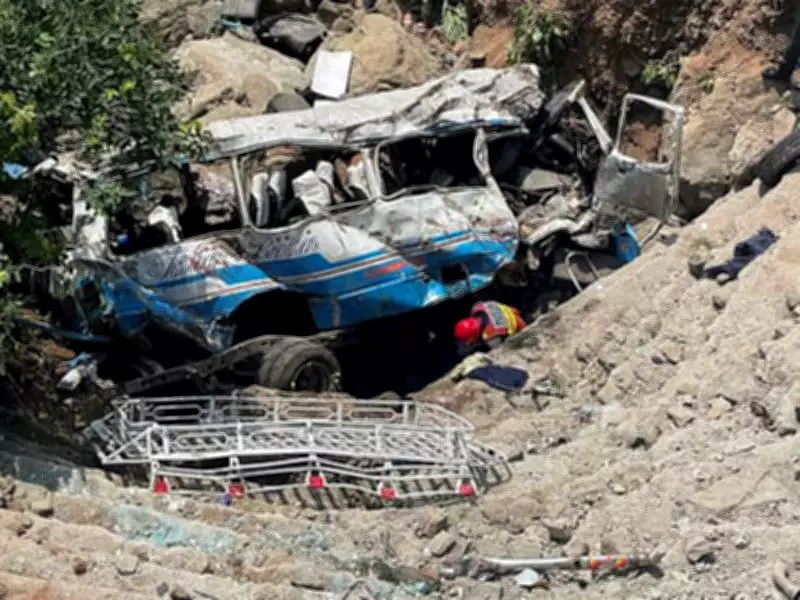
At least 40 people were killed and eight others sustained severe injuries on Friday when an overloaded passenger bus skidded off the hazardous Sherani-Zhob highway and plunged into a deep ravine in the Danasar area of Balochistan, Pakistan, according to a report by The Express Tribune. The incident underscores the perilous state of Pakistan's transport infrastructure and the glaring absence of safety barriers on mountainous routes.
Details of the Accident
The ill-fated vehicle was traveling from Quetta to Islamabad when it traversed the notorious border corridor between Balochistan and Khyber Pakhtunkhwa. The Medical Emergency Response Centre (MERC) confirmed that disaster response teams pulled 40 bodies from the mangled wreckage, while the surviving passengers were rushed to a trauma facility in Zhob.
Large-scale emergency mobilisation saw the deployment of six ambulances, 12 emergency medical technicians (EMTs), and 10 light transport vehicles to the remote crash site, as reported by The Express Tribune. The horrific accident triggered immediate chaos, forcing local administrative units from Sherani and neighbouring Khyber Pakhtunkhwa to rush personnel to the scene.

Official Statements and Overloading Issue
Sherani Deputy Commissioner Hazrat Wali Kakar stated that "the injured were being rescued and shifted to nearby hospitals, while efforts to recover and transport the bodies of those killed were continuing." The official revealed that the vehicle had been heavily overloaded midway through the journey. The Express Tribune quoted Kakar as saying, "The coach departed Quetta carrying 36 passengers, but additional travellers boarded en route after being transferred from another bus that had broken down."
This points to systemic operational failures and lack of regulatory oversight in Pakistan's commercial transit sector.
Emergency Response and Medical Strain
The sudden influx of critical casualties forced authorities to declare a medical emergency at healthcare facilities across Sherani and Dera Ismail Khan, further straining a regional medical system poorly equipped to cope with massive disasters. A joint operation was launched by Rescue 1122, the Frontier Corps (FC), police, and district officials. However, the state of local infrastructure and the difficult mountainous terrain severely complicated recovery efforts.
Investigation and Broader Implications
As public scrutiny intensifies over persistent governance deficits and a lack of accountability regarding public safety, administrative officials confirmed that an official probe had been initiated to ascertain the exact cause behind the fatal plunge, according to The Express Tribune. The accident highlights the urgent need for improved highway safety measures, including barriers and structural safeguards, on Pakistan's high-risk mountainous routes.