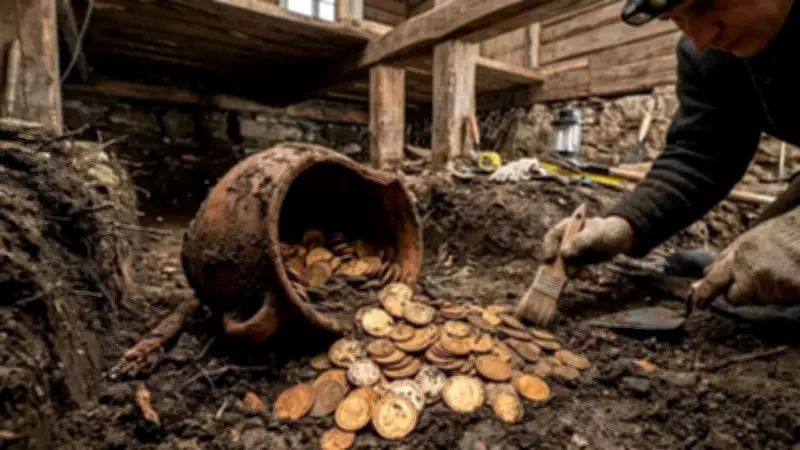
In Torzhok, Russia, a remarkable discovery of 409 Imperial gold coins has been made beneath a house, revealing a mystery over 100 years old about wealth and survival. The treasure came to light during rescue excavations conducted by the Institute of Archaeology of the Russian Academy of Sciences.
Discovery Details
Hidden in a 'kandyushka,' a traditional glazed ceramic pot, the coins lay buried beneath stone foundations. These coins, dating from 1848 to 1911, were predominantly minted during the 1897 monetary reform. Experts believe this is a 'return hoard,' likely hidden during the turmoil of the 1917 Russian Revolution, with plans for retrieval later on. Although historians analyzed tax registers and parish records of the 24 families that once lived nearby, no one knows who owned this immense fortune. It stands as a mute witness to what could have been for an unknown family.
Mystery of Ownership
The treasure itself is safe, but the story behind it remains a mystery. Historians at the Russian Academy of Sciences have examined the site on Sadovaya Street, near what used to be the Church of St. Demetrius. They compared this location with local tax and residency records from the early 1900s. Back then, the area was home to a mix of people: merchants, a bookkeeper, someone from the court, and local clergy members. But after World War II, changes in house numbers and street layouts made it almost impossible to link this foundation to one specific family.

Contents of the Pot
The hoard represents a unique glimpse into the final economic high point of the Russian Empire. As reported in Archaeology Magazine, the collection's total face value is 4,070 rubles. In 1917, this was an enormous amount, valued at over 530,000 dollars in raw gold weight in today's gold value. The coins are divided as follows: 387 are worth 10 rubles each, another 10 are valued at 5 rubles apiece, and there are also 10 coins with a rare 15-ruble denomination from the monetary reform of 1897. Additionally, there are two coins with a value of 7.5 rubles each. The oldest coin dates back to the reign of Nicholas I in 1848, whereas the newest one is from 1911. This timeline suggests that the owner spent many years accumulating this capital before burying it due to revolutionary events.
Museum Exhibition
As noted by the Russian Academy of Sciences, the All-Russian Historical and Ethnographic Museum has assumed stewardship of the collection. This wasn't a lucky find like many treasures; it came from a planned archaeological dig. Because of this, scientists could examine the soil layers and the ceramic vessel closely. The kandyushka, a shattered ceramic vessel, kept the gold safe and dry. After finishing conservation work and cataloging the coins, the museum aims to feature this treasure as a main attraction in its permanent exhibit.