

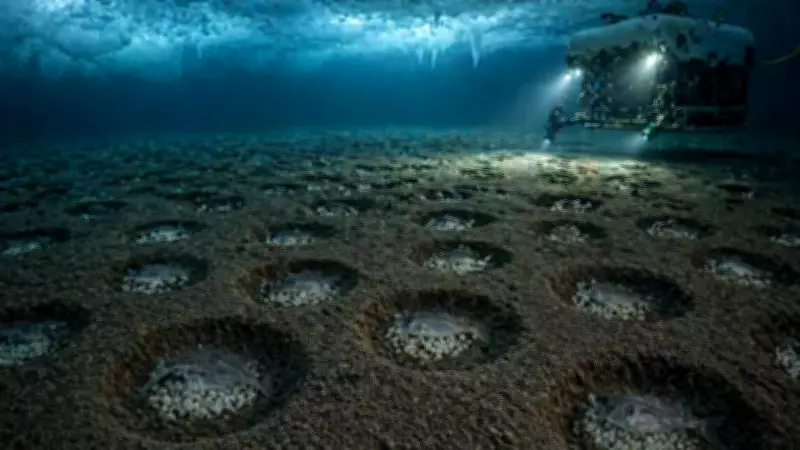
During a routine exploration of the Antarctic beneath the ice, researchers were surprised to observe patterned formations on the seabed. The expedition, originally linked to the search for the wreck of the Endurance, revealed distinct and evenly spaced designs instead of the barren seabed expected from normal monitoring of the Weddell Sea.
Unexpected Discovery of Organized Nests
The presence of these formations was unexpected, contrasting sharply with the surrounding area. It indicated that this part of the ocean was much more active and organized than previously thought, providing insight into how organisms survive in one of the harshest and least studied places on Earth.
The formations were circular holes evenly distributed throughout the sea floor, forming an organized pattern rather than random clusters. Through research, scientists found that the nest formations are widespread, giving rise to what is the biggest breeding ground for these creatures.

Massive Breeding Colony
According to the study titled "A vast icefish breeding colony discovered in the Antarctic", published in the journal Current Biology, the colony covers an area of about 240 square kilometers with over 60 million active nests. Each nest contains an adult fish with approximately 1,700 eggs.
Discovery During an Unexpected Mission
This discovery was never part of the initial objectives for the journey. As scientists used a camera system to study the ocean floor, they began noticing recurring circular patterns. Upon further observation, they discovered these were fish nests, proving that great discoveries can occur even during routine expeditions. The same mission also contributed to locating the long-lost Endurance wreck, showing how exploration can uncover both historical and ecological findings simultaneously.
Cameras played an immense role in such discoveries, highlighting the importance of advanced technology in marine research.
Importance for Marine Ecosystems
The nesting colony is an example of a highly organized breeding community, where a considerable number of Antarctic icefish breed. Nesting colonies provide breeding sites for various predator species as well as nursery areas for other marine organisms, thereby contributing to increased biodiversity. As a result, many predator species can breed successfully due to the favorable conditions present in their habitat. The high biomass within the nesting colony underscores its importance in the Antarctic food chain.
Implications for Science
Previously, scientists believed that most areas beneath the Antarctic ice were unproductive and lacked dense populations or complex ecosystems. However, this discovery shows the possibility of thriving biodiversity in areas subject to extreme environmental conditions. Through identification of such areas, researchers now recognize that these ecosystems need conservation because they may be isolated, making them prone to disappearing due to climate change and human exploitation.
Additionally, the discovery of previously unknown ecosystems may be possible because significant portions of the Antarctic seafloor remain undiscovered.






