

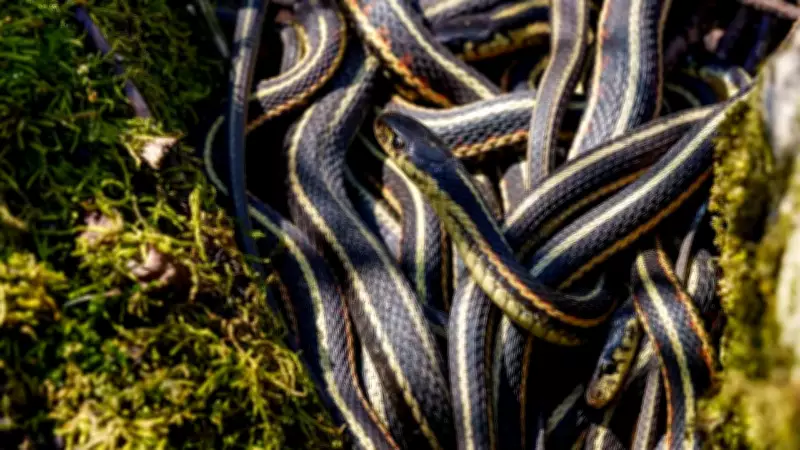
In a quiet corner of Manitoba, Canada, an unusual event unfolds every spring that continues to astonish visitors and researchers alike. The frozen ground, appearing lifeless for most of the year, suddenly begins to move in an almost surreal manner. Thousands of snakes emerge simultaneously from underground limestone dens. The scene at the Narcisse Snake Dens is often described as one of the largest natural gatherings of snakes in the world. It is not a small cluster or a rare sighting; experts estimate that between 75,000 and 150,000 red-sided garter snakes may congregate here during peak season. What makes it even more striking is that this occurs in a place where winter temperatures can drop below -30°C.
The Hidden Underground World
The idea that so many snakes survive in such a harsh environment seems almost unbelievable at first. Yet beneath the prairie surface lies a hidden network of limestone sinkholes and cracks. These spaces, formed millions of years ago, stay slightly warmer than the freezing conditions above. This underground system acts as a natural shelter, allowing the snakes to survive long winters in a state of dormancy. When spring arrives, the entire system comes alive again.
At first glance, the Narcisse area looks like ordinary prairie land—fields, scattered trees, and open, wind-swept spaces. Nothing about it immediately suggests what lies below. However, experts say the real story begins underground. The rock formation is made up of limestone that has been gradually eroded over many years, resulting in deep cracks, sinkholes, and underground tunnels. These caves lie beneath the frost line and never freeze during harsh winters. For the red-sided garter snake, this has become a vital survival environment. They congregate in large numbers in the cave for hibernation, remaining inactive for several months until warm weather returns. It is a simple yet effective survival mechanism that has persisted for many years.

Spring Emergence and Mating Rituals
When spring finally arrives, something remarkable begins. The snakes start to emerge from the dens in large waves. At first, only a few individuals appear, then hundreds follow. Soon, the ground itself seems to shift with life. Observers often describe the scene as overwhelming. Snakes move over each other, across rocks, and through the grass in constant motion. There is no silence; everything is movement. The snakes are not gathering randomly but follow instinct, temperature changes, and chemical signals that guide them toward mating grounds and warmer surfaces.
One of the most fascinating behaviors seen at Narcisse is the formation of mating balls. These occur when many male snakes surround a single female. Sometimes dozens of males compete for access to one female at the same time. Experts suggest that pheromones play a key role in this process. The female releases chemical signals that attract males, who detect them using a special sensory organ in their mouths. Once they locate her, they compete intensely for mating opportunities. The scene can look chaotic, but it follows a biological pattern. Males attempt to position themselves correctly while others try to push in. If successful, one male mates while others continue searching. It is a short but highly competitive moment in their life cycle.
Conservation Efforts and Road Safety
For many years, the snakes faced serious threats while migrating. Highway 17 in Manitoba runs directly through part of their migration path, resulting in thousands of snakes being killed each year by passing vehicles during seasonal movement. Reports from earlier decades suggest that at certain points, as many as 30,000 snakes could die annually in road crossings. Combined with harsh winters, this created a major population risk. Conservation efforts eventually stepped in. Wildlife experts and engineers worked together to build small tunnels under the road. Snow fencing was also installed to guide snakes safely toward these passages. In some cases, scent-based guidance was used to encourage movement through the tunnels. Over time, these measures significantly reduced snake deaths. While losses still occur, the population has stabilized compared to previous decades.

A Rare Natural Phenomenon
The Narcisse Snake Dens remain one of the most unusual wildlife events in the natural world. It is a place where survival, reproduction, and seasonal change all collide in a very visible way. The scale alone is enough to leave a strong impression on anyone who sees it. Even today, researchers continue to study the behavior of these snakes. Every spring, the same pattern repeats itself: the ground warms slightly, the snakes emerge, and the prairie comes alive for a short time before returning to silence again.





