

American Influencer's Viral Video Sparks Debate on India's Realities
Periodically, the global internet community appears to rediscover India through a viral clip or a snowballing comment thread, leading to timelines flooded with sweeping generalizations about the nation. This time, however, the counter-narrative did not emerge from a policy expert or a celebrity panel but from an individual who has quietly built a life in the country over several years.
Grounding the Response in Lived Experience
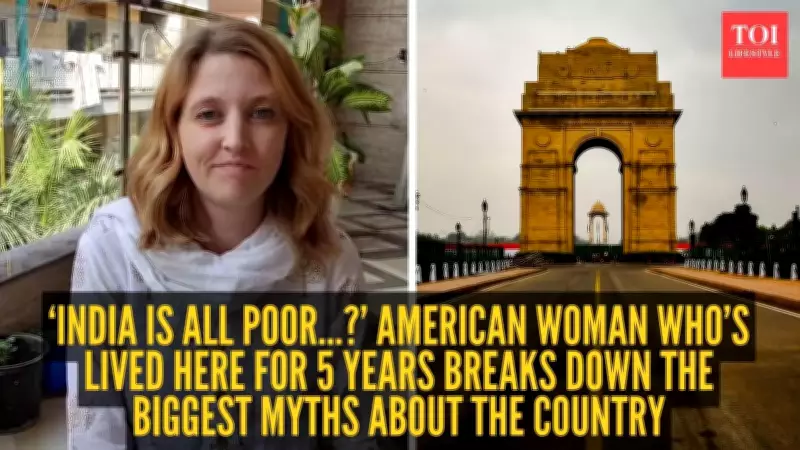
Delhi-based American influencer Kristen Fischer recently shared a video addressing what she identifies as common stereotypes about India. Having resided in the country for nearly five years, she positions her response as firmly rooted in everyday, practical experience rather than abstract analysis.
She introduced the video with a direct and compelling caption: "Let’s clear the air a bit. There are a lot of negative stereotypes out there about India. As a foreigner who has been living in India for nearly 5 years, let me assure you that they are not true. I don't know why Indians are the most hated group online, but here are the facts... What else did I miss?"

The post rapidly garnered significant attention, reigniting a familiar and ongoing debate about the stark contrast between how India is often perceived in online spaces versus how it is genuinely experienced on the ground by residents and long-term visitors.
A Simple 'Lie' and 'Truth' Format to Challenge Misconceptions
The video employs a straightforward and effective structure. Each commonly held stereotype is presented under the label "Lie," followed immediately by what Fischer categorizes as the "Truth," based on her observations and experiences.
One of the primary claims she tackles revolves around hygiene. "Lie: Indians are dirty," the video states, to which Fischer responds, "Truth: Indians bathe more often than other countries and clean themselves with water, not paper." This statement directly confronts a pervasive and frequently circulated trope in various digital forums.
She then addresses economic perceptions. "Lie: India is all poor," is met with "Truth: India has poverty and billion-dollar startups, space missions, and global companies. Two things can be true at once." Rather than dismissing the complex issue of inequality, she astutely points out that multiple, sometimes contrasting, realities can coexist simultaneously, highlighting the nation's robust presence in global business, innovative startups, and advanced technology sectors.
Highlighting Linguistic and Cultural Diversity
Language and cultural identity form another critical pillar of her argument. To the stereotype "Lie: Everyone in India speaks Hindi," she presents "Truth: India has 20+ official languages."
In a subsequent segment, she challenges the notion of cultural uniformity. "Lie: India is one culture," is countered with "Truth: It is more like all of Europe crammed into one country. Languages, food, fashion, and festivals change every few hundred miles." This comparison vividly illustrates the immense scale and variety within the country, especially for international audiences who might mistakenly view it as a monolithic cultural entity.
Rethinking Assumptions on Tradition and Modernity
On the topic of arranged marriages, Fischer writes, "Lie: Arranged marriage means forced marriage." Her clarification states, "Truth: Most arranged marriages are basically family-assisted dating with better background checks," offering a nuanced perspective that moves beyond simplistic Western interpretations.
She further addresses reductive economic labels. To "Lie: India is just call centres," she responds, "Truth: India sends rockets to space and runs half of Silicon Valley." In another frame, she counters familiar visual clichés by pointing instead to the country's thriving technology hubs, modern infrastructure developments, historic architectural wonders, and a rapidly expanding digital ecosystem that rivals global standards.

Audience Reactions: A Spectrum of Agreement, Debate, and Personal Narratives
The response to the video was swift and voluminous. Within hours, the comments section transformed into a dynamic thread filled with personal anecdotes, supportive agreements, and spirited debates. Many users shared their own experiences living in or visiting India, noting how their time in the country had fundamentally altered their perceptions. Others expressed gratitude, stating that the video eloquently articulated thoughts they had harbored for years.
One user, identifying as German and having studied social anthropology in India, commented, "After living in India for social anthropology studies and research, I installed a bidet shower in my bathroom and even carry a portable one while travelling. Who feels clean after wiping with paper?"
Another supporter wrote, "India may not be perfect, but it certainly is not the one-dimensional trope displayed by some influencers. Thank you for highlighting the cultural, linguistic, and economic diversity that exists."
However, not all viewers agreed with every assertion. Some questioned the comparisons made, while others rightly pointed out that individual experiences can vary dramatically depending on geographic region, socioeconomic background, and personal perspective. In many ways, the comment section itself became an extension of the very debate the video sought to initiate.
The Larger Reflection on Perception and Evolving Narratives
What stands out most prominently is how a concise video swiftly evolved into a broader reflection on perception, identity, and national narrative. In the digital age, where opinions propagate at lightning speed and contextual understanding often lags behind, even a simple slideshow can trigger a meaningful moment of collective pause and reconsideration.
Perhaps the ultimate takeaway is that narratives about nations are rarely static or fixed. They are dynamic, constantly shifting entities that face pushback, evolve, and are continually reshaped by each new voice that contributes to the global conversation. Fischer's video serves as a poignant reminder that lived experience remains a powerful tool for challenging stereotypes and fostering a more nuanced, accurate understanding of complex societies like India.





