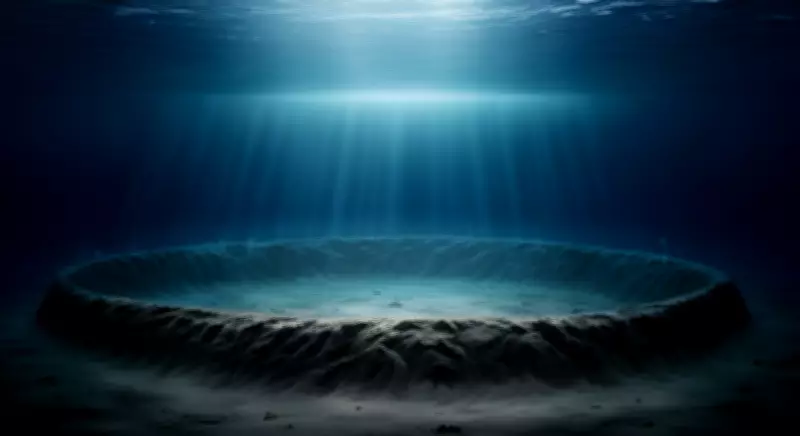
Deep beneath the waves off the coast of Nova Scotia lie what might be among the most significant examples of invisible impact structures ever discovered on the continental shelf. The crater, known as the Montagnais impact structure, has long remained a curiosity due to years of seismic surveys, drilling operations, and rock examinations. Its true significance became known when scientists realized it represents the remnants of an asteroid collision from about 51 million years ago.
Unlike other well-known craters that owe their recognition to being visible to geologists, Montagnais stands out because it was discovered and pieced together through indirect methods. According to the Geological Survey of Canada, Montagnais became the first recognized impact structure formed by a meteorite striking the seafloor.
A Strange Circular Structure Beneath the Scotian Shelf
The first hints of the crater emerged from offshore oil and natural gas exploration in the Scotian Shelf region south of Nova Scotia. Using seismic reflection technology, researchers discovered a large circular structure with a central raised area and shattered rock surrounding it. Initially, it was unclear whether the structure was caused by an asteroid impact. Some suggested the formation might be due to volcanism or other geological processes, as there was no exposed crater on the surface; instead, it was covered with marine sediments.

A 1987 study published in Nature by Lubomir F. Jansa and Georgia Pe-Piper described the structure as an underwater extraterrestrial impact crater on the North Atlantic continental shelf. The paper noted the presence of breccia and shock deformation features that strongly supported an impact origin. Additional seismic surveys revealed that the crater was approximately 45 kilometers wide and exhibited characteristics of a complex impact structure, including a central uplift. The US Geological Survey reports that Montagnais shares geological features with large craters formed by asteroid impacts on Earth, despite its underwater location.
Drilling Revealed the Decisive Evidence
One of the best proofs came when exploratory drilling encountered the center of the structure, revealing fractured basement rocks, breccia, and impact melts. The drilling also uncovered planar deformation features in quartz and feldspar, which are classic markers for shock waves generated by asteroid impacts. Additionally, evidence of suevite—a rock created during violent collisions—was found. The drill hole went through more than 500 meters of shattered and melted rock. Original volcanic deposits were reclassified as impact-generated deposits.
Scientists stated that the combination of seismically derived geometry, drill core evidence, and shock minerals was crucial. The shape alone could not prove an impact; the physical rock evidence helped transform Montagnais from an offshore mystery to a proven impact structure.
Dating the Collision to the Early Eocene
The crater was later dated to the Early Eocene era, approximately 50.5 to 51 million years old. These dates were achieved through radiometric techniques, including argon isotopic analysis of melt rocks retrieved from drilling. This age was further supported by fossil-rich sediment layers surrounding the crater, formed after the impact.
Montagnais provided important insights into scientists' assumptions about where such structures could persist. It demonstrates that continental shelf regions and marine margins can hide craters under thick sediment layers for tens of millions of years. Later studies found that the impact could have caused significant slope instability and mass movements along segments of the Scotian margin.
The broader conclusion from studying Montagnais is the importance of a scientific approach to identifying such structures. The discovery resulted from numerous findings rather than a single revelation, highlighting the value of integrating multiple lines of evidence.