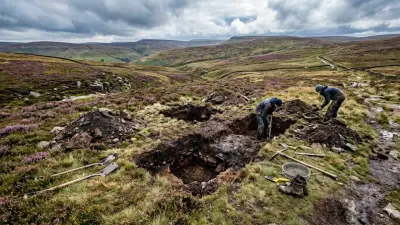
Somewhere beneath the fields of Saxony, a family once stretched wool across a wooden loom, stored grain against the winter, and slept beside their cattle in a timber hall long enough to fit a modern tennis court. We do not know their names. We do not know what language they spoke around the fire. But for the first time in nearly two millennia, we know exactly where they lived. Archaeologists from the Landesamt für Archäologie Sachsen, the state office for archaeology in Saxony, have uncovered a remarkably well-preserved rural settlement in Liebersee, a village within the Belgern-Schildau district, along the fertile left bank of the Saxon Elbe Valley. The excavation ran from December 2025 through April 2026, covering 3,200 square metres of ground that was days away from being consumed by a gravel extraction operation. What they found there rewrites, in quiet but significant ways, what we know about ordinary life at the edge of the Roman world.
A village beyond Rome: How ordinary families lived 1,700 years ago
The site dates to the late Roman Imperial period and the early Migration Period, roughly the 3rd through 5th centuries CE, a time when the Roman Empire was straining at its borders, and the Germanic peoples beyond them were building worlds of their own. History books fill entire chapters with emperors and battles from this era. This dig is about none of that. It is about the people who never made it into the history books.
At least four timber longhouses were identified at the site, each measuring up to 20 metres long and five metres wide. Their scale is significant. These were not temporary shelters. They were permanent, carefully constructed buildings, combining living quarters and animal housing under one roof. The choice to keep livestock inside was a practical one: in cold northern winters, the body heat of cattle and pigs warmed a home from below. Three smaller pit-houses, ranging from 7 to 12 square metres, were also uncovered, likely used as workshops, storage cellars, or utility spaces.

Inside a 1,700-year-old workshop: Ancient tools reveal a hidden industry
The most astonishing room in the village is one of those small pit-houses. Inside, archaeologists recovered 30 clay loom weights, the heavy stones or fired-clay pendants that kept threads taut on an upright loom, along with a clay spindle whorl used for spinning raw wool into thread. Together, these objects constitute a complete textile workshop. This was not casual domestic spinning. The volume of equipment suggests organised, dedicated production, possibly supplying more than just the household that operated it.
A reminder that ordinary objects carry extraordinary power. Then came the object that stopped everyone cold. Buried among the weaving tools was a large dark glass bead with pale wavy lines running across its surface, beautiful, clearly precious, and entirely out of place in a working workshop. Glass beads of this type are typically found in female burials from the 4th and 5th centuries CE. This one, researchers believe, had been deliberately repurposed as a spindle whorl: a piece of jewellery transformed into a tool. Whether it belonged to the weaver, was inherited, or traded from somewhere far away, no one can say. But it speaks to a person who found a way to keep something beautiful and useful.
The fire mystery: What happened to this village 1,700 years ago
The settlement did not simply fade. Something happened here. Scattered across the site, archaeologists found charred grain and fragments of reddish burnt clay, the remnants of a fire significant enough to leave its mark 1,700 years later. The grain tells us the community was storing cereals, both for eating and for seeding the following year's crop. The burnt clay suggests walls or plaster structures reached temperatures high enough to fire. Whether this fire was accidental, the result of conflict, or part of a deliberate decision to abandon and burn the settlement, the excavation has not yet revealed. Radiocarbon dating of the charcoal and plant remains is currently underway, which should help establish when exactly the fire occurred and whether it marked the end of occupation or a period of rebuilding.

Saved by accident, lost if not for the calendar
This site exists in the archaeological record only because gravel extraction was scheduled. The Landesamt für Archäologie Sachsen conducted a rescue operation ahead of the machines. Had the dig not been ordered in time, the longhouses, the loom weights, the glass bead and the charred grain would have been scooped away and processed into aggregate. The region around Liebersee already had a history of archaeological finds. Earlier surveys had flagged the area as high-priority, but even so, the window between knowledge and destruction was narrow. It is a pattern repeated across Europe: development creates a deadline, and archaeologists race to meet it. Some sites are saved. Many are not.
The forgotten lives of the people who built this village
What this excavation offers, ultimately, is not another story about power. It is a story about maintenance, about the daily, unglamorous, essential work of staying alive. The residents of Liebersee did not build monuments. They built roofs. They spun wool. They stored food. They kept animals close in winter and worked clay into the shapes they needed. They lived, evidently for some decades at least, in a way that was organised, skilled and self-sufficient. That they disappeared is not the tragedy. Settlements move, communities scatter, names are forgotten. The tragedy would have been losing the evidence that they were ever here at all.