In a remarkable discovery that bridges the gap between ancient history and modern archaeology, researchers in China have unearthed a significant stretch of a 2,200-year-old imperial highway. This find provides tangible evidence of the Qin Straight Road, an engineering marvel commissioned by China's first emperor to consolidate his vast empire.
A Monumental Infrastructure Project Rediscovered
The discovery was officially announced on December 9, 2025, following an extensive survey initiated the previous year by the Cultural Heritage Protection and Research Institute of Yulin, located in Shaanxi province. The newly identified segment spans an impressive 13 kilometres (8 miles) and offers fresh, physical insights into one of the ancient world's most ambitious infrastructure endeavours.
Historical records state that Qin Shi Huang, the formidable first emperor who unified China, ordered the construction of this direct route. Its primary purpose was strategic: to enable the rapid movement of troops and supplies from the capital, Xianyang (in modern-day Shaanxi), to the northern frontier at Jiuyuan (present-day Baotou in Inner Mongolia). This was crucial for defending the empire against nomadic tribes, particularly the Xiongnu. Astonishingly, this massive project, part of a coordinated northern defence system that included the early Great Wall, was reportedly completed in just five years.

Advanced Engineering Ahead of Its Time
The excavations along this Yulin section have revealed sophisticated engineering techniques that were far ahead of their era. Archaeologists documented several key features:
- Straight, continuous trench passes carved through the landscape.
- Reinforced slopes constructed from rammed earth for stability.
- Compacted roadbeds and valleys that were deliberately filled to maintain a level route.
The road was colossal in scale, averaging about 40 metres (130 feet) in width—broad enough to accommodate what would equate to four modern traffic lanes. In some sections, it expanded to an even more impressive 60 metres. Evidence of multiple trampled surfaces, compacted by relentless foot and wheeled traffic, points to the road's intensive and sustained use over time.
Adding to the significance, a small auxiliary site believed to be a relay station was found nearby. Ceramic fragments recovered there indicate it remained operational from the Qin dynasty through the succeeding Han dynasty (206 BC—AD 220), underscoring the road's role as a long-term logistical artery, not just a short-lived project.
Historical Significance and Lasting Legacy
Dubbed "the ancestor of the world’s highways" by China Cultural Heritage News, the Qin Straight Road is considered the second-largest national defence project in ancient China, after the Great Wall. The ancient historian Sima Qian documented the project in his Records of the Grand Historian, noting that construction began in 212 BC and was finished in 207 BC, after the emperor's death.
The road and the wall worked in tandem: the wall served as a defensive barrier, while the straight road allowed for swift military deployment. Ironically, this very efficiency later backfired. When central authority waned, the well-built route allowed nomadic invaders to penetrate deep into Chinese territory. Historical documents note that Han dynasty authorities deliberately destroyed parts of the road at least three times to prevent this.
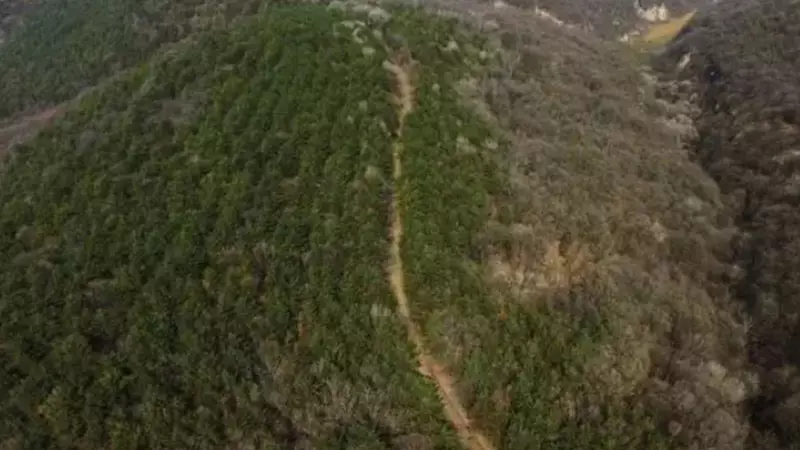
Finding the Yulin section was particularly challenging, as much of the area had been consumed by the Mu Us Desert. Only recent re-greening efforts made the terrain investigable. By comparing historical texts with satellite imagery, archaeologists spotted faint linear features, leading to the confirmation of nine continuous trench sections aligned in a dead-straight line.

This discovery not only corroborates ancient accounts but also highlights the incredible pre-industrial engineering capabilities of the Qin dynasty. It confirms that over two millennia ago, China built one of the world's earliest long-distance transport networks—a vital artery that played a fundamental role in holding its first empire together.