

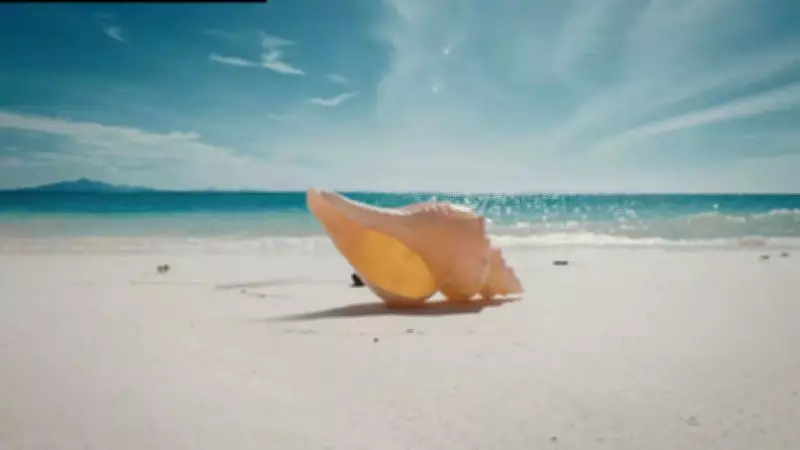
Australian Trumpet Snail's Diet Revealed: A Giant Predator of Marine Worms
Along the Western Australian coast, large shells often lie partially buried in tidal mud, belonging to Syrinx aruanus, commonly known as the Australian trumpet. This species is recognized as the largest living sea snail, with some shells reaching lengths of approximately 91 centimetres. While long prized by collectors, the biology of this giant snail has remained poorly documented, leaving many aspects of its life a mystery.
Field Observations Uncover Feeding Habits
A small population near the Burrup Peninsula provided a unique opportunity for researchers to observe living individuals in shallow intertidal flats. Their goal was straightforward: to gather clearer evidence on what this animal eats and how it feeds. Earlier, limited notes had suggested a diet of large marine worms, but concrete documentation was scarce.
Through meticulous fieldwork, specimen examination, and laboratory analysis, scientists have now provided firmer details about its feeding habits and ecological role. They watched several snails moving slowly across mudflats at low tide, noting a long, flexible proboscis extending into the sediment and down worm tubes. This feeding organ appeared capable of reaching well below the surface, indicating active predation rather than accidental contact.

Diet Confirmed Through Faecal Analysis
By temporarily holding a few individuals, researchers collected faecal samples that contained remains of large tube-dwelling polychaete worms. Identifiable fragments linked the snail to worm families such as Acoetidae and Terebellidae, as well as species similar to Diopatra. These findings were consistent across multiple samples, solidifying the diet evidence.
Unique Feeding Strategy Among Large Sea Snails
Many large predatory sea snails, such as those in related groups, feed on molluscs or echinoderms, often drilling or prying open hard shells. In contrast, Syrinx aruanus appears specialized for soft-bodied prey hidden in sediment. Its radula and extensible proboscis are well-suited for this behaviour, while its heavy shell provides structural support for muscle attachment, stabilizing the animal during feeding movements below the surface rather than serving as a hunting tool.
Conservation Implications and Family Links
The study, titled "Food of giants – field observations on the diet of Syrinx aruanus (Linnaeus, 1758) (Turbinellidae) the largest living gastropod," places this species within broader patterns seen in the Turbinellidae family. Several relatives are also known to consume polychaete worms, suggesting a consistent feeding strategy rather than an isolated habit.
With populations reduced in accessible areas due to shell collecting, clearer knowledge of diet and habitat may assist in conservation planning. For a species so large and familiar in appearance, much of its everyday life had remained uncertain. These modest details help fill a significant gap in understanding, offering insights that could aid in protecting this remarkable marine creature.






