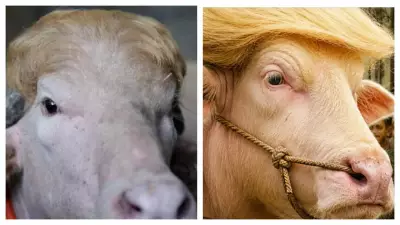
A buffalo in Bangladesh named 'Donald Trump' became an overnight viral sensation. Crowds gathered from afar to marvel at its appearance, astonished by its blond fringe, fair white skin, and immense weight. Many were shocked to learn it might soon be sacrificed for Eid al-Adha. However, fate intervened, and the collective global audience sighed in relief when the animal was spared.
This buffalo, owned by farm owner Ziauddin Mridha, cost 1.5 million taka (about $12,300). The Bangladesh government decided to send Donald to Dhaka's national zoo instead of allowing it to be slaughtered. The animal's resemblance to the former US president made it an internet sensation, adding to the pantheon of viral animals like Larry the Cat, Moo Deng the pygmy hippo, and Punch the lonely monkey.
Animals in Human History
Long before the algorithm turned animals into celebrities, humans revered them as gods, omens, and symbols. Cave paintings from over 40,000 years ago depict animals like horses, bison, and lions, showing their early importance. In the Indus Valley Civilisation, the Pashupati seal depicts a horned figure surrounded by animals, suggesting an early idea of divinity as a lord of beasts.

Across ancient cultures, gods were often associated with animals. In Hinduism, gods rode vahanas (vehicles) and took animal avatars. Egyptian gods like Horus (falcon), Anubis (jackal), and Bastet (cat) had animal heads. Greek mythology saw Zeus transform into a bull, swan, or eagle. The Roman Empire used the eagle as a symbol of statecraft, while Chinese cosmology featured the dragon, phoenix, tiger, and tortoise as guardians of direction.
Sacrifice and Pardon
The concept of animal sacrifice has deep roots. The word 'sacrifice' comes from Latin 'sacer' and 'facere', meaning 'to make sacred'. In Mesopotamia, offerings were made to gods like Enlil and Marduk. In Egypt, sacrifices maintained ma'at (cosmic order). Ancient India performed the Ashvamedha ritual, where a horse roamed freely for a year.
In Judaism, animals were offered to Yahweh as burnt offerings, peace offerings, and sin offerings. The scapegoat of Yom Kippur carried the community's sins into the wilderness. Christianity transformed sacrifice through Jesus, the 'Lamb of God', who replaced repeated blood offerings. In Islam, Eid al-Adha commemorates Ibrahim's willingness to sacrifice his son, with an animal taking his place.
The Modern Pardon
The tradition of pardoning animals gained modern prominence with the US Thanksgiving turkey pardon. Abraham Lincoln's son Tad pleaded for a Christmas turkey named Jack to be spared. President John F. Kennedy spared a turkey in 1963, and George H.W. Bush formalized the pardon in 1989. This ritual reflects humanity's enduring desire to feel compassionate by sparing an animal.
Donald Trump the buffalo's survival echoes this tradition. Its viral fame transformed it from a potential sacrifice to a zoo resident, showing that in the age of algorithms, even animals can become celebrities worthy of mercy. The story highlights how humanity oscillates between sacrificing animals to appease gods and sparing them to feel more human.