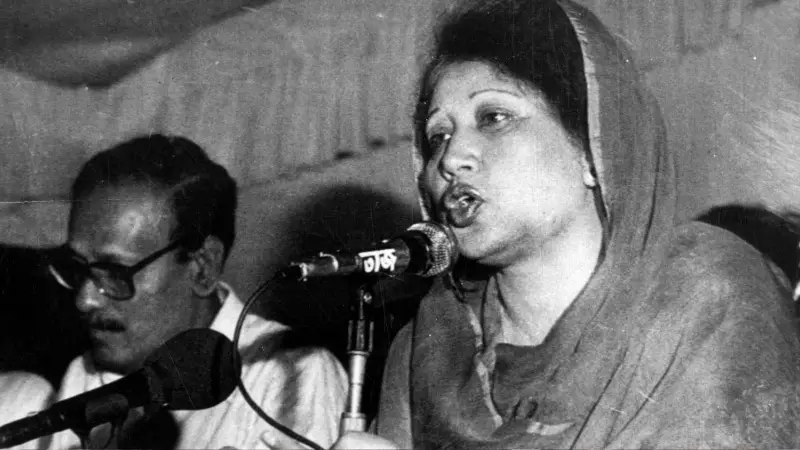
Bangladesh's first woman Prime Minister, Begum Khaleda Zia, passed away on Tuesday at the age of 80, closing a tumultuous chapter in the nation's history. A central figure who shaped the country's politics for over three decades alongside her arch-rival Sheikh Hasina, Zia's tenure was marked by democratic restoration, economic reforms, and a notably complex relationship with neighbouring India.
The Political Journey: From First Lady to Prime Minister
Khaleda Zia entered the political arena following the assassination of her husband, President Ziaur Rahman, in 1981. A political novice, she rose to lead the Bangladesh Nationalist Party (BNP) in 1984. She spearheaded the movement against General Hussain Muhammad Ershad's military regime, demonstrating strategic acumen by temporarily allying with Sheikh Hasina to oust Ershad and restore democracy.
Her political zenith came with victory in the 1991 elections, making her Bangladesh's first female premier. During her first term (1991-1996), she presided over the critical transition from a presidential to a parliamentary system. Key policy initiatives included introducing the Value-Added Tax (VAT) in 1991, making secondary education free for girls in rural areas, and institutionalising the caretaker government system for overseeing national elections.

A Tumultuous Relationship with India
Khaleda Zia's two terms in power were defined by a turbulent and often strained relationship with India. She interacted with three Indian Prime Ministers: P.V. Narasimha Rao, Atal Bihari Vajpayee, and Manmohan Singh. Her second term (2001-2006) left particularly bitter memories for New Delhi.
During this period, after aligning with the right-wing Islamist party Jamaat-e-Islami, anti-India terrorist groups and insurgent outfits from India's northeast found safe haven in Bangladesh. This state of affairs severely impacted bilateral ties, leading India to warmly welcome Sheikh Hasina's return to power in 2008, after which Dhaka clamped down on anti-India activities.
Zia also navigated the delicate fallout of major communal events in India. She was in office during the Babri Masjid demolition in 1992 and the Gujarat riots of 2002. In a 2014 interview, she recalled taking immediate action to prevent communal flare-ups in Bangladesh, stating her government blocked TV coverage of the demolition and that her ministers worked to protect the Hindu community.
The 'Battle of the Begums' and Political Decline
The fierce rivalry between Khaleda Zia and Sheikh Hasina, dubbed the 'Battle of the Begums', became legendary. After their brief unity in 1990, their competition dominated Bangladeshi politics. A pivotal moment came in 2013 when Zia's BNP decided to boycott the general elections, protesting Hasina's move to scrap the caretaker government system. This decision was widely seen as a "political blunder" that allowed the Awami League to consolidate power.
The subsequent decade (2014-2024) saw the BNP under intense pressure from the Hasina regime. Zia and many party leaders faced imprisonment. In 2018, she was convicted on corruption charges related to the Zia Orphanage Trust and was jailed in the old Dhaka Central Jail. Although conditionally released in 2020 due to the Covid-19 pandemic and ill health, she remained confined to her Gulshan residence.
Her son, Tarique Rahman, returned to Dhaka on December 25 as her health worsened in recent weeks. Zia's legacy remains contested, yet her party appears poised to contest the 2026 elections under Tarique's leadership, potentially testing her own belief that in democracy, acceptance by the people is the ultimate key to power.