

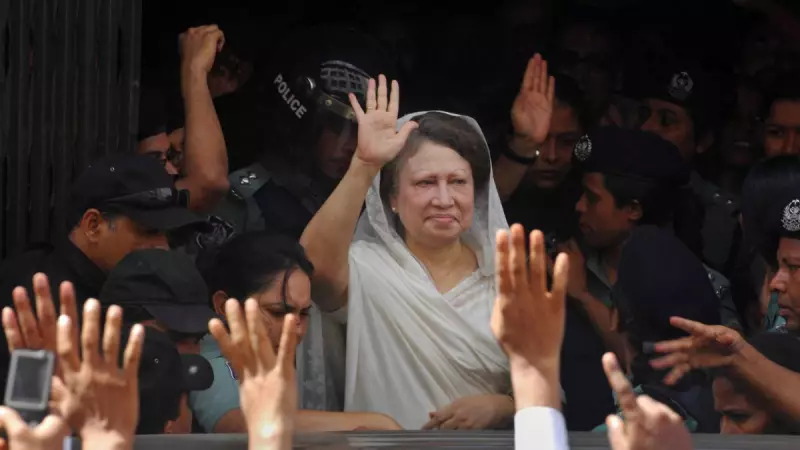
Begum Khaleda Zia, the former Prime Minister of Bangladesh and the chairperson of the Bangladesh Nationalist Party (BNP), has passed away. She was 79 years old. Her death marks the end of an era for the nation's politics, where she was a central figure for decades, serving as the country's first woman prime minister and leading one of its two major political forces.
A Political Journey Forged in Tragedy
Khaleda Zia's entry into the volatile arena of Bangladeshi politics was not by design but through circumstance. Born on August 15, 1945, in the Dinajpur district, her life took a dramatic turn following the assassination of her husband, President Ziaur Rahman, in 1981. Ziaur Rahman was the founder of the Bangladesh Nationalist Party (BNP). Thrust into the spotlight, Khaleda Zia took over the leadership of the BNP, transforming from a private figure into a formidable political opponent.
Her perseverance paid off when she led the BNP to a decisive victory in the 1991 parliamentary elections. This win made her the first woman to become the Prime Minister of Bangladesh. She would go on to serve two more terms, leading the government from 1991 to 1996 and again from 2001 to 2006. Her tenure was characterized by a focus on development and a foreign policy that sought to strengthen ties with other Islamic nations and the Western world.

Legal Battles and Declining Health
The latter part of Khaleda Zia's life was dominated by legal challenges and a prolonged struggle with illness. After her political rival, Sheikh Hasina, and the Awami League returned to power, Zia faced a series of corruption convictions. The most prominent was the Zia Orphanage Trust graft case, for which she was sentenced to prison in 2018.
Her health deteriorated significantly during her incarceration. Diagnosed with liver cirrhosis and other ailments, she was eventually released from jail in 2020 on an executive order by the government, conditional on her receiving medical treatment at home and not traveling abroad. For the past several years, she was largely out of the public eye, receiving medical care at a hospital in Dhaka's Gulshan area. Her condition was reported as critical in the days leading to her passing.
A Complex Legacy and an Uncertain Future for the BNP
Khaleda Zia's legacy is deeply intertwined with the modern history of Bangladesh. Alongside current Prime Minister Sheikh Hasina, she defined the nation's bitter and often confrontational two-party politics. Her supporters revered her as a symbol of resistance and a champion of her husband's political vision. To her detractors, her rule was marred by allegations of corruption, political violence, and hardline tactics.
Her death creates a significant vacuum at the top of the BNP, which has already been struggling as the primary opposition party. The immediate question is who will succeed her as the party's chairperson. Her son, Tarique Rahman, currently serves as the BNP's acting chairman but lives in exile in London. His leadership from abroad presents a major challenge for the party's unity and organizational strength within Bangladesh.
The passing of Khaleda Zia closes a major chapter in the story of Bangladesh. It removes a pivotal figure from the political landscape, one whose life was a testament to both personal resilience and the intense, dynastic nature of the country's governance. The nation now watches to see how her party evolves and what shape the political opposition will take in her absence.






