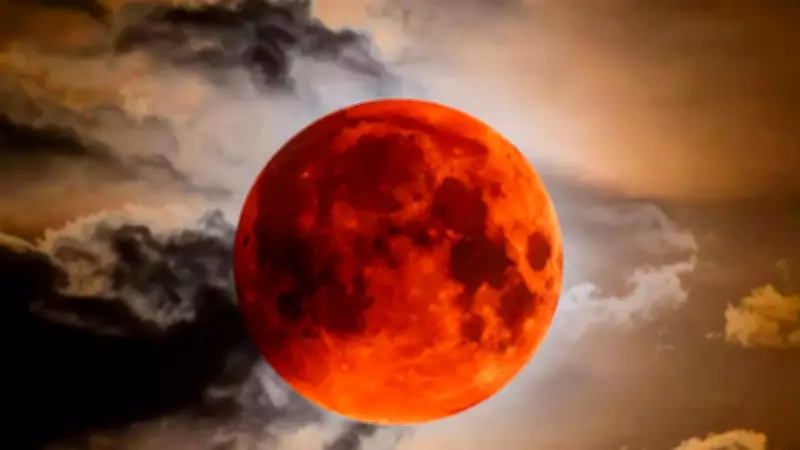
Blood Moon 2026: Rare Total Lunar Eclipse to Coincide with Holi Festival
On March 3, 2026, a celestial spectacle will grace the skies as the Moon turns a deep, coppery red during a rare total lunar eclipse. This event, popularly known as a Blood Moon, holds special significance as it coincides with the vibrant festival of Holi, creating a natural festival of color in the heavens. For skywatchers across India, this offers a unique opportunity to witness astronomy and tradition merge in a breathtaking display.
Eclipse Timing and Visibility Across India
The total lunar eclipse of March 3, 2026, begins in the late afternoon. The penumbral phase commences around 4:58 PM Indian Standard Time (IST), with totality—when the Moon is fully immersed in Earth's shadow—lasting approximately 58 minutes, concluding around 5:32 PM. Maximum eclipse occurs between 5:10 PM and 5:25 PM, varying slightly by location.
For most of India, the Moon will rise during the eclipse, meaning only the final stages may be visible. However, even catching the glowing red Moon emerging over the eastern horizon at dusk is described as a magical experience. Unlike many astronomical events, this one requires no late-night vigil; simply step outside at twilight and look eastward.

State-by-State Viewing Guide
Visibility varies significantly across the country. Several northeastern states will experience the total eclipse, while others will see partial phases. Here is a detailed breakdown:
- Total Lunar Eclipse States: Andaman and Nicobar Islands, Arunachal Pradesh, Assam, Manipur, Meghalaya, Mizoram, Nagaland, Tripura, and West Bengal. In these regions, the Moon rises already in eclipse, with totality beginning between 5:04 PM and 5:30 PM IST.
- Partial Lunar Eclipse States: Andhra Pradesh, Bihar, Chandigarh, Chhattisgarh, Delhi, Goa, Gujarat, Haryana, Himachal Pradesh, Jammu and Kashmir, Jharkhand, Karnataka, Kerala, Lakshadweep, Madhya Pradesh, Maharashtra, Odisha, Pondicherry, Punjab, Rajasthan, Sikkim, Tamil Nadu, Telangana, Uttar Pradesh, and Uttarakhand. Here, only the penumbral and partial phases are visible as the Moon rises.
According to data from Timeanddate.com, the eclipse ends universally across India at 7:53 PM IST, marking the conclusion of the penumbral phase.
Why the Moon Turns Red: The Science Behind the Blood Moon
A Blood Moon occurs during a total lunar eclipse when Earth positions itself directly between the Sun and the Moon. This alignment casts Earth's shadow, known as the umbra, across the lunar surface. While direct sunlight is blocked, Earth's atmosphere acts as a natural lens, filtering out shorter wavelengths like blue and violet light through a process called Rayleigh scattering.
The longer red and orange wavelengths bend around our planet and illuminate the Moon, giving it that characteristic coppery glow. Essentially, when you gaze at a Blood Moon, you are witnessing the combined reflection of all the sunrises and sunsets occurring on Earth at that moment—a truly surreal phenomenon.
Global Visibility and Viewing Tips
Globally, the eclipse will be visible from Europe, Asia, Australia, North America, South America, the Pacific, Atlantic, Indian Ocean, Arctic, and Antarctica. For optimal viewing in India:
- Find a location with a clear, unobstructed view of the eastern horizon.
- Minimize exposure to bright city lights to enhance visibility.
- While binoculars or a telescope can reveal finer details, they are not necessary; the eclipse is easily visible to the naked eye.
- Popular spots include rooftops, beaches, and hilltops, especially in Northeast India where the red Moon rising over landscapes like hills or rivers creates unforgettable memories.
Enthusiasts are already planning viewing parties, particularly in northeastern states, where the eclipse coincides with Holi celebrations, adding a cultural layer to the astronomical event. Total lunar eclipses occur a few times annually worldwide, but visibility from India is not guaranteed each time, making this 2026 occurrence particularly noteworthy.

As the date approaches, expect increased sharing of photos and experiences online, capturing the Blood Moon framed by urban skylines or natural vistas. This event serves as a reminder of the wonders above, accessible to all who simply look up at the right time.