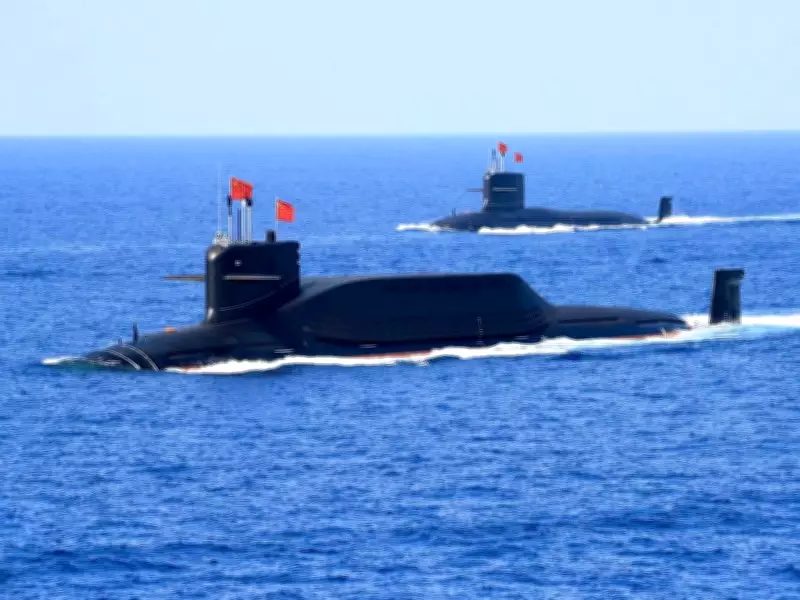
New Sailless Submarine Spotted at Jiangnan Shipyard
Satellite imagery captured on May 31 at Jiangnan Shipyard in Shanghai revealed a mysterious new submarine lacking a traditional sail or conning tower. The France-based Naval News first highlighted the vessel, noting that China's latest design dispenses with the sail, marking a step in the evolution of its submarine force. The boat's location is notable as Jiangnan has not previously built nuclear-powered submarines.
H I Sutton, a submarine expert and report author, stated that the submarine's main features include a sleek bow, X-form rudders, and minimal sail. He noted that China has experimented with sailless submarines before, with one built at the same yard. The configuration is likely chosen to reduce drag. The submarine is approximately 120 meters long and 10-11 meters wide. Sutton said it is unquestionably a new class, though definitely not a nuclear-powered ballistic-missile submarine (SSBN).
Possible Type 095 at Huludao Shipyard
Around the same time, another submarine may have been launched at Huludao Shipyard in Liaoning, traditionally a site for nuclear-powered submarines. First observed in February, analysts initially took it to be the long-awaited Type 095 nuclear-powered attack submarine (SSN). However, the Huludao submarine is slightly shorter but wider than the Shanghai vessel, leaving it debatable which design is the actual Type 095.

Sutton discussed other implications, noting that questions remain regarding the new submarine's role and propulsion. For the latter, standard nuclear propulsion seems most likely given the boat's size. If conventionally powered, it would be by far the largest conventional boat afloat. China has been developing a form of propulsion coupling a low-power nuclear reactor as air-independent propulsion (AIP), first adopted in the Type 041 Zhou class launched in 2024. However, Sutton concluded that nuclear AIP seems unlikely for the new Shanghai boat.
Rapid Expansion of PLAN Submarine Fleet
China steadfastly refuses to reveal new submarine types, leading to speculation whenever a new class appears. However, the pace of production is undisputed: between 15 and 20 submarines across eight distinct classes have been launched in the past five years alone. Rear Admiral Mike Brookes, Intelligence Director of the US Office of Naval Intelligence, testified before the US-China Economic and Security Review Commission in early March that China's submarine force is projected to reach roughly 70 boats by 2027, up from the current 60+. This could include six new guided-missile nuclear-powered attack submarines (SSGN), three smaller-class SSNs, and two SSBNs. Brookes predicted that by 2035, the PLAN could have 80 submarines, half of which are nuclear-powered, describing it as a major shift in force composition.
This growth spurt comes as the US Navy's SSN fleet reaches a nadir of 46 vessels in 2030. China is thought to be launching an average of three new SSNs annually, compared to no more than 1.3 per year in the USA. Looking further ahead, China may have 20-30 new-class SSGNs and SSBNs in service by the early 2040s, designed for blue-water operations and persistent presence beyond the First Island Chain.
Global Interest in Nuclear Submarines
China is not alone in valuing nuclear-powered submarines. Australia, under the AUKUS agreement, plans to buy three second-hand Virginia-class SSNs from the USA, with new SSN-AUKUS boats to follow. South Korea formally launched its plan for developing SSNs on May 26, aiming to commission its first submarine in the late 2030s. Dr. Kim Jae Yeop of the Sungkyun Institute for Global Strategy told ANI that Seoul wants to counter Pyongyang's submarine-launched ballistic missile threats and possess a survivable deterrent against neighboring powers like China. He noted that South Korea's acquisition of SSNs may prompt Japan to pursue similar capabilities.

Xi Jinping's Role in Submarine Prioritization
Chairman Xi Jinping has been prominent in demanding the PLAN prioritize nuclear-powered submarines. Ryan D. Martinson, in a report for the China Maritime Studies Institute, noted that Xi has participated in at least 15 engagements with the PLAN since assuming power in 2012, including inspecting nuclear submarine units and attending vessel commissions. Xi personally decided to prioritize the construction of nuclear-powered ballistic missile submarines, build a carrier-centric navy, establish China's first overseas military base, and expand the PLAN Marine Corps. He declared that threats to national security are mainly at sea, the focus of military struggle is mostly at sea, and the center of gravity of the nation's expanding national interests is at sea.
Strategic Implications of SSBN Expansion
David C Logan, in a separate report, outlined implications of the PLAN's ballistic missile submarine force expansion. The SSBN force will likely impose new demands on other fleet elements for defense, whether in bastion areas close to Chinese shores or open-ocean patrols. Bastion operations would reduce operational demands but require transiting the First Island Chain. An oceangoing strategy would allow submarines to launch ballistic missiles on trajectories avoiding American ballistic missile defenses. Additionally, the PLA will need to develop personnel reliability and warhead handling programs for the SSBN force, potentially changing its historically centralized approach to nuclear weapons.
Brookes highlighted dramatic increases in China's domestic submarine production capacity through major infrastructure investments at three primary shipyards, accelerating production from less than one nuclear submarine per year to significantly higher rates. These investments have tripled construction hall capacity and enabled higher production rates for conventional and larger-diameter advanced submarines, positioning the PLAN for sustained force expansion through the 2030s and beyond.