A new Pentagon assessment has concluded that China is systematically developing military options to threaten Taiwan with brute force, while simultaneously enhancing its ability to project power far beyond its shores, directly challenging US security interests in the Indo-Pacific.
Steady Progress Towards 2027 Goals
The annual report on China's military power states that the People's Liberation Army (PLA) is making consistent advances in sophisticated weaponry and expanding its operational reach. A central focus remains Taiwan, which Beijing claims as its own territory. The report explicitly notes, "the PLA continues to refine multiple military options to force Taiwan unification by brute force."
Despite this aggressive posture, the assessment reveals a critical internal doubt. As of last year, Chinese leaders "remain unsure of the PLA’s readiness to successfully seize Taiwan." This uncertainty persists even as President Xi Jinping has directed the military to develop capabilities for a forced takeover of the island by 2027.

In 2024, Chinese forces conducted exercises simulating key components of an invasion, including amphibious landings, firepower strikes, and a maritime blockade against Taiwan. Provocations have also increased sharply, with incidents in Taiwan’s air defence identification zone jumping over 60% from 1,703 in 2023 to 2,771 in 2024.
Nuclear Expansion and Global Power Projection
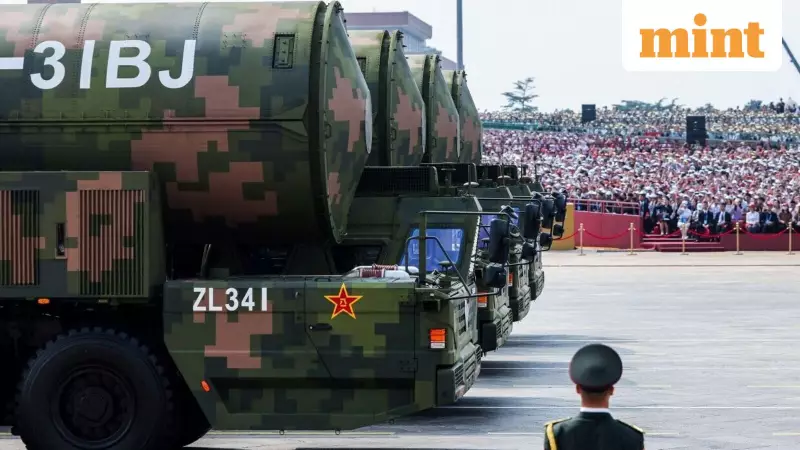
The Pentagon's first China military report of the Trump administration's second term highlights a growing threat to the American homeland. China currently possesses an estimated stockpile of more than 600 nuclear warheads and is undergoing a "massive nuclear expansion," putting it on track to field over 1,000 warheads by 2030. However, the pace of building new warheads has slowed compared to recent years.
Beijing has consistently rejected US calls for arms-control talks, arguing it must first catch up to the arsenals of Washington and Moscow. The report also details ambitious naval plans, clarifying for the first time that China aims to operate nine aircraft carriers by 2035. Its third carrier, the domestically designed Fujian, features advanced electromagnetic launch systems similar to the US Navy's newest Ford-class carriers.
Beyond the Taiwan Strait, China is building a global military footprint. This includes a logistics and training centre at a Cambodian naval base inaugurated in April and a sustained military presence in Djibouti near the strategic Red Sea.
US Response and Strategic Calculations
The evolving threat is shaping American policy. Last week, the Trump administration approved a significant $11 billion arms sales package to Taiwan, including missile launchers, anti-tank missiles, artillery, and drones. Paradoxically, President Trump has simultaneously played down the likelihood of a Chinese attack and seeks to deepen ties with Xi Jinping ahead of an April summit.
The US continues its decades-old policy of "strategic ambiguity" regarding Taiwan—neither confirming nor denying if it would intervene directly in a conflict—to deter both a Chinese attack and a Taiwanese declaration of independence. The new Pentagon report states the administration will seek wider military communications with China and other ways to signal peaceful intentions.
At 100 pages, this year's assessment is about half the length of the previous one released under the Biden administration. Experts like Tom Karako of the Center for Strategic and International Studies noted "less detail on military hardware than in past years, and a surprising emphasis on improved U.S.-China relations and mil-to-mil cooperation." The report aligns with a broader US national-security strategy focusing on defending the Western Hemisphere and working with Pacific allies to deter action against Taiwan, while framing China primarily in economic terms.