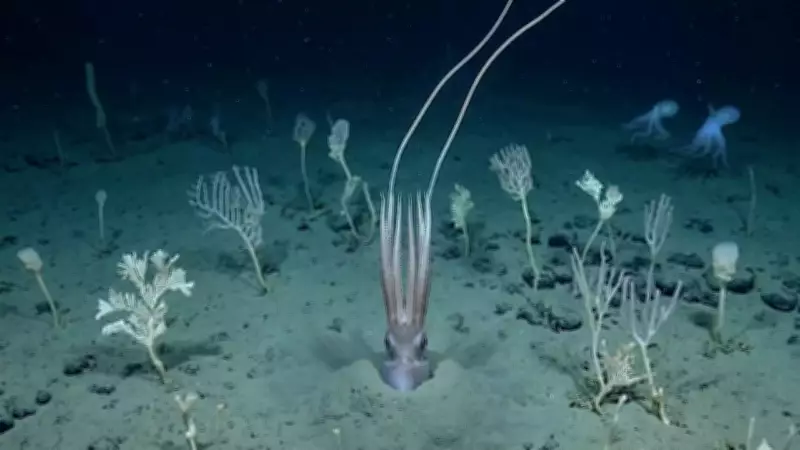
Groundbreaking Discovery of 'Muddy Squid' in Pacific Depths
In a landmark achievement for marine biology, researchers have documented the first-ever footage of a previously undescribed species of whiplash squid exhibiting an extraordinary form of aggressive mimicry. This remarkable creature was filmed at a staggering depth of 4.1 kilometers in the Clarion-Clipperton Zone (CCZ) of the Pacific Ocean, revealing behaviors that challenge existing understanding of deep-sea biodiversity.
Unprecedented Footage Reveals Tree-Like Camouflage
The astonishing video, captured by the National Oceanography Centre (NOC) using high-definition cameras on the remotely operated vehicle Isis, shows the squid positioning itself vertically on the seafloor. By inserting its head into soft mud and stiffening its arms to trail upward, the squid transforms into what appears to be a tree or plant-like structure. This deliberate posture represents a sophisticated survival strategy never before documented in such detail.
Scientific Significance of Aggressive Mimicry
This behavior constitutes what scientists term aggressive mimicry – a form of deception where the squid blends seamlessly with its surroundings of sea sponges and stalks. The adaptation serves dual purposes:

- Evading predators that hunt in deep-sea environments
- Ambushing unsuspecting prey that mistake the squid's tentacles for harmless marine flora
Researchers emphasize that the clarity of the footage confirms this was not accidental positioning but intentional camouflage, demonstrating advanced morphological adaptations in extreme conditions.
Additional Discoveries in the CCZ
During the same SMARTEX expedition, scientists identified evidence of another new squid type believed to belong to the Mastigoteuthidae family. These findings collectively underscore how technological advancements in deep-sea exploration are revealing previously unknown aspects of marine life, particularly in regions like the CCZ that remain largely unexplored.
Implications for Deep-Sea Conservation
The discovery of this "muddy squid" highlights significant knowledge gaps regarding abyssal ecosystems. As National Oceanography Centre researchers note, this footage demonstrates that the deep seabed constitutes a complex, three-dimensional habitat teeming with life that has evolved remarkable adaptations.
With increasing interest in deep-sea mining activities, these findings emphasize the urgent need for comprehensive biological surveys to protect these unique organisms from irreversible damage before we fully understand their ecological roles and evolutionary significance.
Future Research Directions
The groundbreaking documentation of this aggressive mimicry behavior provides compelling evidence that even well-known marine predators like squid possess extraordinary survival strategies that have evolved under extreme pressure conditions. This discovery opens new avenues for research into:
- The evolutionary mechanisms driving such sophisticated camouflage
- The ecological dynamics of deep-sea food webs
- The potential existence of similar adaptations in other marine species
As exploration technology continues to advance, scientists anticipate further revelations about the mysterious life forms inhabiting Earth's deepest ocean regions, reminding us how much remains to be discovered beneath the waves.