Groundbreaking Fossil Discovery in Texas Cave Challenges Climate History
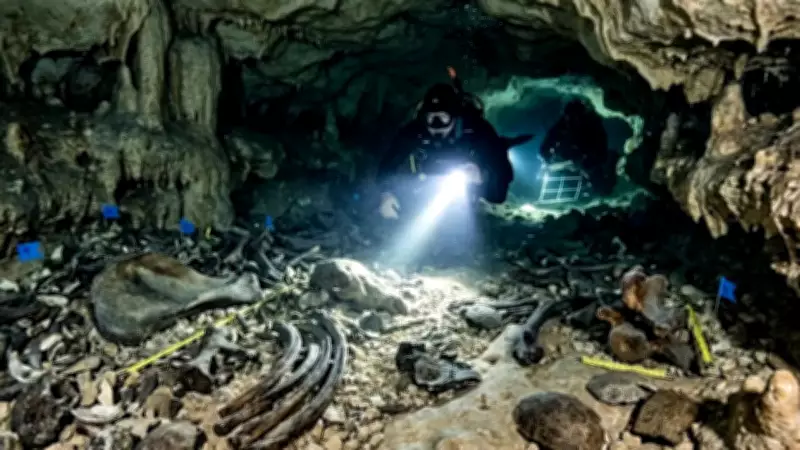
A remarkable discovery deep within the submerged passages of Bender's Cave on the Edwards Plateau in Comal County, Texas, is reshaping scientific understanding of the region's ancient climate. During a snorkeling expedition through the dark, low-ceilinged underground stream, researchers uncovered an extensive collection of Pleistocene megafauna fossils, including species never before documented in this area.
Unprecedented Fossil Assemblage in Active Stream
The research, published by Cambridge University Press, details how scientists identified bones from mammoths, mastodons, sabre-toothed cats, and giant ground sloths preserved in what's known as a 'lag assemblage' on the cave floor. These fossils were mineralized and coated with calcite from prolonged exposure to carbonate-saturated underground water, creating exceptional preservation conditions rarely found in such environments.
Rare Species Discovery Forces Climate Reevaluation
According to findings from the Jackson School of Geosciences and The University of Texas at Austin, the most significant discoveries were bones from a giant tortoise (Hesperotestudo) and a pampathere (Holmesina septentrionalis). The pampathere, approximately lion-sized and related to modern armadillos, represents a particularly important find since neither species had previously been identified on the Edwards Plateau.

The presence of these animals presents a major scientific anomaly because both species require warm, humid, frost-free climates to survive. This contradicts established climate models for the Late Pleistocene period in the Edwards Plateau, which have traditionally depicted the region as dominated by cool, dry grasslands.
Advanced Analysis Reveals 100,000-Year-Old Climate Evidence
University of Texas researchers faced significant challenges in accurately dating the fossils. Initial radiocarbon analysis of bioapatite suggested an age of approximately 17,000 years, but this proved inaccurate due to carbonate contamination within the cave environment. Through sophisticated cluster analysis techniques, scientists determined the fossils actually date to marine isotope stage 5, placing them at more than 100,000 years old.
This dating breakthrough indicates the fossils originated during a warm climate period that significantly predates previous estimates, providing crucial evidence that Central Texas experienced much warmer and more humid conditions than previously believed during certain Pleistocene intervals.
Innovative Underwater Exploration Methodology
The investigation represents one of the first formal studies of water-filled cave systems in Texas. Unlike traditional dry cave excavations, researchers utilized snorkel gear, wetsuits, and specialized underwater lighting to navigate the submerged passages with limited visibility. This innovative approach enabled scientists to sample 21 distinct zones along the stream bed, demonstrating that underwater cave systems can serve as exceptional repositories for paleobiological records.
The successful exploration methodology has established new protocols for investigating submerged cave environments, opening possibilities for similar discoveries in other water-filled cave systems across Texas and beyond.