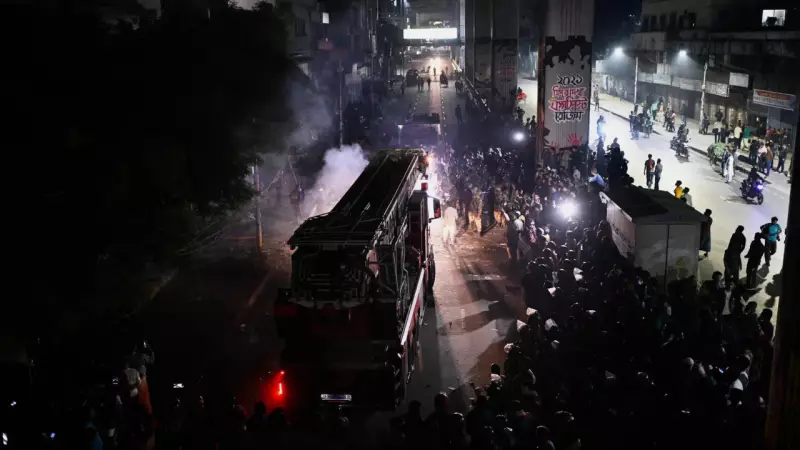
A fresh wave of violent protests has swept through Bangladesh's capital, Dhaka, following the tragic death of a prominent young political leader. The unrest reached a critical point when mobs targeted and set fire to the offices of two of the country's leading newspapers, Prothom Alo and The Daily Star, in a severe blow to press freedom.
The Trigger: Assassination of a Youth Leader
The chain of events was set in motion by the killing of Sharif Osman Hadi, a 32-year-old student leader and a key figure from last year's political uprising. Hadi was shot in the head by masked gunmen on December 12 while campaigning in the Motijheel area of central Dhaka. He succumbed to his injuries six days later in a Singapore hospital.
Hadi, an alumnus of the University of Dhaka, had emerged as the convenor and spokesperson for Inquilab Mancha, a platform staunchly opposed to established political domination. He was a fierce critic of the ruling Awami League and the broader political elite, positioning himself as a voice for a new generation seeking radical change.

The "Darkest Night" for Bangladeshi Media
In the volatile atmosphere following Hadi's death, anger spilled onto the streets. Around midnight, hundreds of his supporters gathered, chanting slogans before attacking the building housing the newspapers. Sajjad Sharif, the executive editor of Prothom Alo, described the harrowing incident as the "darkest night" for newspapers in Bangladesh.
"Some miscreants vandalised our media house. Our journalists were working on the next day's edition when they were attacked and had to flee for their lives," Sharif narrated. He revealed the profound impact of the attack: For the first time in its 27-year history since 1998, Prothom Alo could not publish its newspaper, and its online portal was forced offline.
Sharif framed the assault as a direct attack on democratic pillars, stating, "It's an attack on our freedom of speech and freedom of the news media." He urgently called upon the government to launch a proper investigation to identify and prosecute those responsible.
Unrest Amid Political and Electoral Tensions
The killing of Hadi and the subsequent violence have reignited political instability at a sensitive juncture. Bangladesh is currently preparing for a crucial national election, and the incident adds a layer of complexity to the nation's internal and external political recalibrations.
Authorities confirmed that Hadi was attacked while in a rickshaw near Box Culvert Road. The gunshot wound near his left ear caused massive blood loss. Police have stated the motive and perpetrators of the initial assassination remain unclear.
Following the confirmation of his death by interim chief adviser Muhammad Yunus, protests erupted not just in Dhaka but in other cities as well. Demonstrators vandalised buildings, torched vehicles, and targeted symbols associated with the political establishment, with the newspaper offices becoming a focal point of their fury.
This episode underscores the deep-seated tensions within Bangladeshi society and poses serious questions about the safety of journalists and the stability of the nation as it approaches a pivotal electoral process.