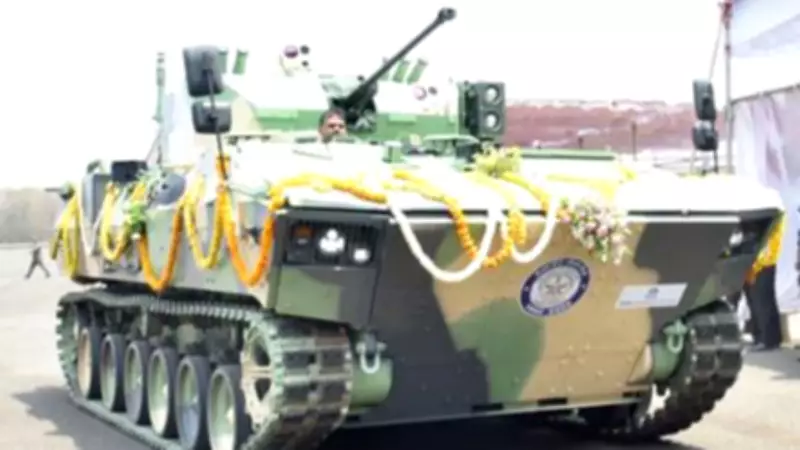
The Vehicles Research and Development Establishment of the Defence Research and Development Organisation (DRDO) has unveiled its Advanced Armoured Platforms (AAP), designed to meet the emerging operational requirements of the Indian Army. These platforms are available in both tracked and wheeled configurations.
The DRDO states that the vehicles have been designed to address the evolving needs of the army and will compete to replace the Indian Army's BMP-2K Sarath Infantry Fighting Vehicles (IFVs), which have been in service since the 1980s. The platforms were jointly produced by Tata Advanced Systems Limited and Bharat Forge.
Key Features of the Advanced Armoured Platforms
The Advanced Armoured Platforms are equipped with a high-power engine, automatic transmission, and a high power-to-weight ratio. They possess amphibious capabilities, incorporating two hydro-jets for water operations.

The Indian Army is seeking to replace its BMPs through the Future Infantry Fighting Vehicle (FICV) program. Armoured Vehicles Nigam Limited (AVNL), a government-operated entity, along with private sector participants such as Mahindra Defence Systems, Larsen & Toubro (L&T), and Tata Motors, are at various stages of development.
Procurement Plans and Requirements
The army is likely to procure between 2,000 and 2,200 vehicles as per a capability development roadmap released last year. However, a Request For Information (RFI) for FICVs released in 2021 pegs the number at 1,750 tracked vehicles.
According to a source in the army, the army currently has 50 battalions of the Brigade of the Guards and the Mechanised Infantry Regiment operating BMPs, with each unit having around 60 to 70 vehicles in different variants. The overall requirement is estimated to be well over 3,500 vehicles, including both tracked and wheeled varieties, plus reserves.
The source explained that tracked vehicles are required for desert and semi-desert areas in Rajasthan and Gujarat, while wheeled vehicles are preferred in the plains of Punjab and hilly or mountainous terrain.
Armament and Protection
The DRDO-developed vehicle is armed with a crewless turret equipped with a 30mm cannon and a 7.62mm machine gun, along with two ready-to-fire anti-tank guided missiles. The crewless turret provides additional space in the chassis, allowing troops to carry extra equipment such as drones or loitering munitions (LM) into battle. The vehicle also requires the capability to defend against LMs.
The platform offers up to STANAG Level-5 protection for its occupants, providing a strong level of defense against most direct and indirect fire weapons. The army's capability development roadmap specifies a 360-450 horsepower engine requirement.
Implications for the US Stryker
The rollout of this vehicle raises questions about the US Stryker, a wheeled armoured platform. The Stryker lacks amphibious capability, a key requirement for the Indian Army, and has not performed well in high-altitude regions.