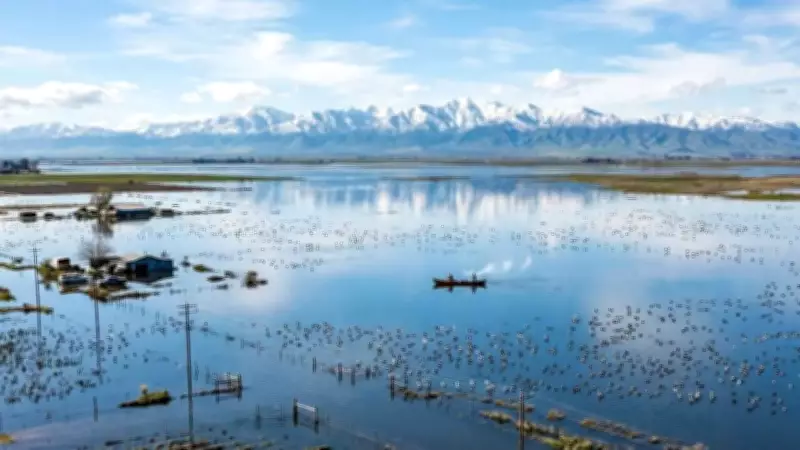
Tulare Lake, once known as Pa'ashi by the Tachi Yokut tribe, has made a surprising comeback. This rare event shows how a long-gone terminal lake can reclaim its original basin. It used to be the largest freshwater lake west of the Mississippi until it was drained in the late 1800s for farming purposes.
How the Lake Reappeared
In 2023, extreme weather and record snowfall in the Sierra Nevada refilled the basin, covering over 100,000 acres. This occurrence underscores California’s unpredictable water cycles and points out modern flood control's limitations. Besides affecting the Central Valley’s economy, the lake's return has sparked an ecological revival, drawing many migratory birds and renewing indigenous cultural areas.
California’s Largest Lost Body of Water Resurfaces
According to the California Department of Water Resources, the Tulare Lake basin is a terminal sink for the Kings, Kaweah, Tule, and White rivers. While it was considered ‘extinct’ due to 20th-century water diversions and land reclamation for farming, the basin remains a natural topographic depression. In 2023, the sheer volume of runoff from the Sierra Nevada exceeded the capacity of man-made canals and dams, allowing the water to follow its natural gravity-driven path back into the ‘Ghost Lake.’

How 12 Atmospheric Rivers Revived a Lost Lake
The re-emergence was fueled by a ‘Big Fill’ event caused by a series of more than 12 atmospheric rivers. These storms created a snowpack that was nearly 300 per cent of the normal average in the southern Sierra Nevada, as noted in the California Department of Water Resources. As this record snowpack melted, it overwhelmed the Kings River and Tule River watersheds, leading to sustained flooding in the low-lying agricultural polders of the Tulare Lakebed.
How a Dried Basin Reactivated Its Biological Cycles
Despite being a disaster for local infrastructure, the resurfaced lake immediately functioned as a critical stopover on the Pacific Flyway. Ornithological observations recorded tens of thousands of waterbirds, including American Avocets, Black-necked Stilts, and various duck species, nesting in the newly formed wetlands. This rapid colonisation demonstrates the ‘ecological memory’ of the landscape, where dormant seeds and biological cycles reactivate upon inundation.
The Survival of Indigenous Pa’ashi
For the Tachi Yokut Tribe, the lake's return is the restoration of Pa’ashi. Research indicates that the lake was central to the region's biodiversity and indigenous sustenance for centuries before it was diverted. The resurgence has allowed tribal members to perform traditional ceremonies on the water for the first time in generations, emphasising that the ‘lake never died,’ but was merely suppressed by industrial engineering.