

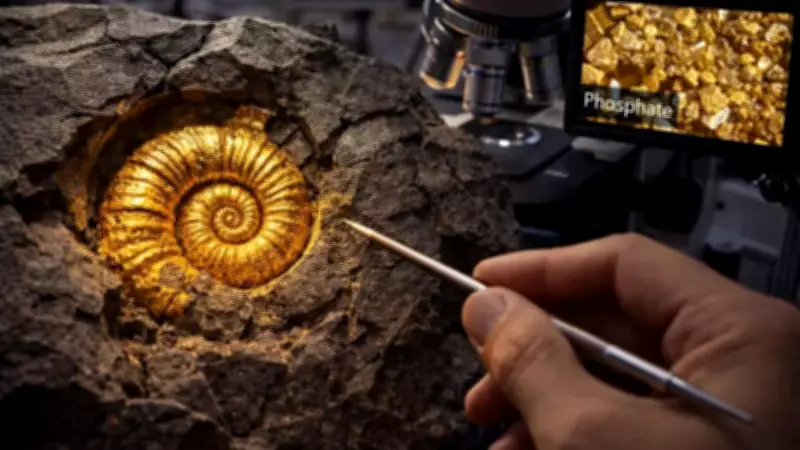
Golden-Looking 183-Million-Year-Old Fossils Were Misidentified for Decades
For decades, a collection of fossils that appear to shine like gold has quietly misled scientists. Found in black shale deposits in southwest Germany, these 183-million-year-old remains, primarily ammonites, were long considered classic examples of pyritisation. In simple terms, researchers believed the original biological material had been replaced by pyrite, a mineral often called fool's gold due to its metallic luster. This idea seemed logical and was widely accepted across the scientific community.
New Analysis Challenges Long-Held Assumptions
According to recent research, new analysis has started to challenge that assumption. Using advanced microscopy techniques, scientists have taken a closer look at these fossils and uncovered something entirely unexpected. The golden appearance is not originating from where experts once thought. For years, the internal structure of these fossils was assumed to be rich in pyrite. That belief fundamentally shaped how researchers understood their preservation process. The metallic look reinforced the idea, and few questioned it in detail until now.
When scientists examined the fossils under a scanning electron microscope, the results told a dramatically different story. They found almost no pyrite within the fossil material itself. In some samples, only a handful of tiny crystals were present. Instead, the fossils appear to be composed largely of phosphate minerals. This process, known as phosphatisation, occurs when organic material is preserved very early, before it fully breaks down. Experts note that this type of preservation is relatively rare and can retain fine structural details that are often lost in other fossilisation processes. So the fossil itself is not metallic in composition, even though it looks that way to the naked eye.

What Creates the Golden Illusion?
The source of the golden glow seems to reside in the surrounding rock rather than inside the fossil. The black shale that encases these remains contains large numbers of microscopic pyrite structures called framboids. These tiny formations are clustered and highly reflective. When light hits them, it scatters in a manner that creates a metallic sheen. To the human eye, the effect looks as though the fossil itself is shining brilliantly. Researchers counted hundreds of these framboids in the rock around a single specimen, while inside the fossil, there were only a few. That stark contrast suggests the golden effect is largely visual and not indicative of the fossil's actual composition.
Low Oxygen and Brief Oxygen Pulses Preserved the Fossil
These fossils originated from the Toarcian Oceanic Anoxic Event, an era that existed approximately 183 million years ago when most areas in the ocean experienced extremely low oxygen concentrations. Oxygen deficiency likely caused slower rates of decomposition, hence the high-quality preservation of fossils from this region. However, it may not be the only factor at play. From the research, it appears that there was a brief interval where oxygen concentration in the water was higher. This may have triggered chemical reactions resulting in phosphates replacing the biological materials before decomposition took place. While oxygen is generally associated with fast rates of decomposition, oxygen deficiency could play a critical role in preserving fossils. According to the researchers, it may be crucial to the fossilisation process, highlighting a complex interplay of environmental conditions.
What This Fossil Reveals About Earth's Past and Future
The distinction may appear insignificant at first glance, but it fundamentally alters the perception of one of the most extensively investigated fossil sites in the world. The Posidonia Shale has long served as a reference point in paleontology research. Any misinterpretation of this site's preservation conditions could impact the analysis of analogous samples worldwide, potentially leading to revised understandings of ancient ecosystems.

A contemporary relevance of these fossils becomes evident when considering the decrease in the ocean's oxygen content. According to recent data, global oceanic oxygen concentrations have fallen by two percent from the mid-20th century onwards. By analysing how this factor changed in the past, researchers can predict future developments more accurately. This discovery not only corrects a historical error but also provides valuable insights into how environmental shifts, both ancient and modern, affect preservation and biodiversity.





