

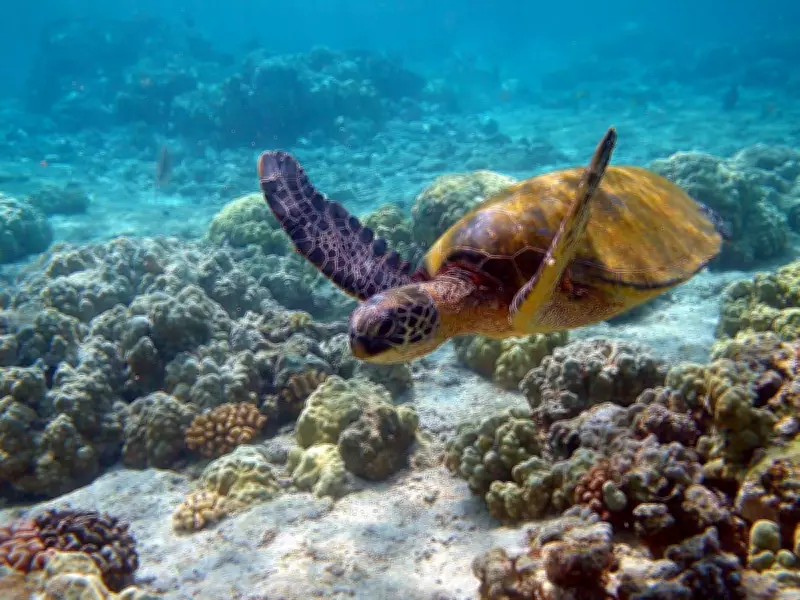
What initially appeared to be graffiti on the shells of green sea turtles in Hawaii has evolved into a large-scale community-based conservation initiative. For years, beachgoers and swimmers in the region observed peculiar markings on the turtles' shells, often assuming they were acts of vandalism. This confusion prompted the National Oceanic and Atmospheric Administration (NOAA) to clarify the markings and launch a public reporting program called Honu Count in 2017, as reported by Hawaii Public Radio. The project, named after the Hawaiian green sea turtle, encourages the public to report sightings of marked turtles.
Why Scientists Mark Sea Turtles
According to NOAA Fisheries, Hawaiian green sea turtles undertake remarkable long-distance migrations associated with nesting. Researchers have documented that these marine animals can travel over 1,200 miles round-trip from feeding grounds in the main Hawaiian Islands to nesting sites at Lalo (French Frigate Shoals) within the Papahanaumokuakea Marine National Monument. To effectively track these turtles for migration studies and conservation, NOAA researchers temporarily mark them by applying white alphanumeric codes on the shell surface. The process involves using a Dremel tool, similar to those used by nail technicians, to etch the outer shell layer before applying non-toxic white paint. The marking is painless, as it only affects the outer shell layers, and many turtles sleep through the procedure.
A Misunderstanding That Inspired Action
As noted by Hawaii Public Radio, some observers were concerned about potential vandalism. Instead of dismissing these concerns, researchers saw an opportunity to educate the public and involve them in conservation. Thus, the Honu Count project was created, inviting citizens to report sightings of marked turtles along with location, time, and date. This provides crucial data on migration routes, foraging areas, and individual turtle movements. Additionally, this method allows scientists to gather information from a much larger geographic area than traditional surveys.

Hundreds of Reports Are Shaping Research
The community response has been impressive. NOAA Fisheries reports that nearly 600 individuals have submitted 688 sightings of 253 distinct turtles since the project began in 2017. This data is used for scientific research, with studies showing that shell etching, community participation, and online surveys have improved population assessments of Hawaiian green sea turtles. Researchers find community-collected data particularly valuable for identifying foraging areas and understanding how turtles use marine habitats across the Hawaiian Islands chain. The reporting program has provided insights into locations where turtles gather to feed.
Strengthening Conservation Through Community Involvement
Scientists emphasize that the program's significance extends beyond data collection. Honu Count has raised public awareness about conservation and turtle research. Reports from the program help scientists determine habitat use, track nesting turtles after reproductive migrations, and analyze how the population responds to environmental changes, including global warming impacts. This project exemplifies how citizen involvement can complement traditional wildlife monitoring. While satellite tracking remains important, the low-cost approach of shell marking and citizen reports yields valuable data. Each submitted photo adds a piece to the larger puzzle, and for ordinary citizens, spotting a tagged turtle can contribute to scientific research.
What began as concern over potential defacement has become a collaboration between scientists and the local community to preserve Hawaii's honu (green sea turtles).






