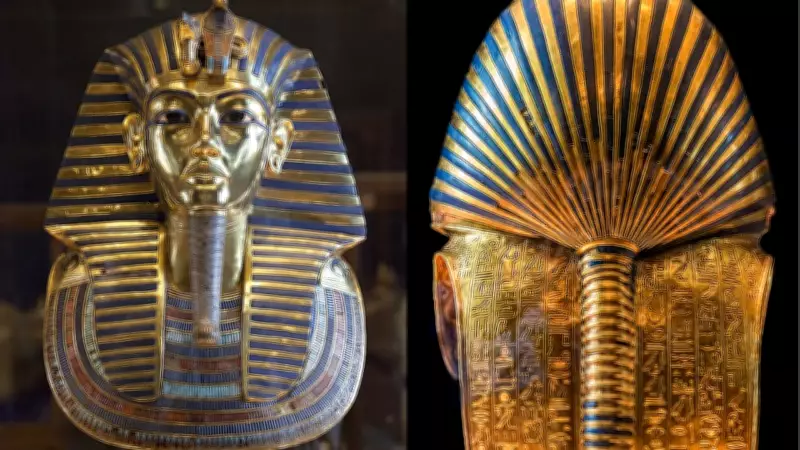
Few artefacts capture the imagination quite like the gold funerary mask of Tutankhamun. Since its discovery in 1922, the dazzling masterpiece has become the defining symbol of ancient Egypt, recognised worldwide for its craftsmanship and royal splendour. Yet one of the mask's most remarkable secrets remains largely unseen. Hidden on the back of the iconic treasure is a lengthy hieroglyphic inscription containing a powerful funerary spell intended to safeguard the young king in the afterlife.
Drawn primarily from the ancient Egyptian Book of the Dead, the text was believed to shield Tutankhamun's body, preserve his soul and guide him through the dangers of the underworld. More than 3,300 years later, the inscription continues to offer an extraordinary glimpse into Egyptian beliefs about death, immortality and divine protection.
The secret hieroglyphic spell engraved on the back of Tutankhamun's gold mask
While the front of Tutankhamun's mask is renowned for its serene royal portrait, the reverse bears a carefully engraved inscription that runs across the shoulders and back of the artefact. The text consists of protective funerary formulas adapted from several ancient religious compositions, particularly Chapter 151B of the Book of the Dead. According to Egyptologist Raymond O. Faulkner's translation of the spell in his book The Book of the Dead: "Your right eye is the night bark, your left eye is the day bark; your eyebrows are the Ennead. Your pate is Anubis; the back of your head is Horus. Your fingers are Thoth; your braided tress is Ptah-Sokar." Individual identifications may vary, but the cumulative effect is that "there is no limb in you devoid of a god."

The inscription invokes divine protection from a range of deities and identifies the deceased king with powerful cosmic forces. Ancient Egyptians believed that such words possessed magical efficacy, transforming written language into a form of spiritual protection. Unlike modern memorial inscriptions, these texts were intended to function actively within the afterlife, ensuring that the deceased could overcome supernatural dangers and achieve eternal existence.
Why ancient Egyptians believed sacred words could grant immortality
For the ancient Egyptians, writing was never merely decorative. Hieroglyphs were considered sacred and were closely associated with divine creation itself. Religious texts placed within tombs, coffins and funerary equipment were designed to assist the deceased on their journey beyond death. The spell engraved on Tutankhamun's mask reflects a central Egyptian belief: survival in the afterlife depended upon divine protection, ritual knowledge and the preservation of the body. George Andrew Reisner wrote in The Egyptian Conception of Immortality: "The words themselves possessed magical power and efficacy."
The inscription invokes gods including Osiris, Anubis, Horus and Ra, creating a spiritual shield around the young king. Each line was intended to protect a different aspect of his being, from his physical remains to his soul and divine identity. This fusion of religion, art and magic explains why funerary objects in royal tombs were often covered with sacred texts rather than simple decoration.
What the inscription reveals about Tutankhamun and ancient Egyptian beliefs
The mask itself was crafted from more than 10 kilograms of gold and adorned with lapis lazuli, quartz, obsidian and coloured glass. Yet the inscription may be even more valuable to historians than the precious materials. Its wording reflects the religious transformation of the late Eighteenth Dynasty following the reign of Tutankhamun's father, Akhenaten, whose controversial reforms challenged traditional Egyptian worship. The text demonstrates a return to conventional funerary beliefs centred on Osiris, the ruler of the dead.

Howard Carter's transcripts by the Griffith Institute, from when he discovered the tomb in 1922, described the mask as: "A beautiful and unique specimen of ancient portraiture. In detail, the mummy is wrapped to represent Osiris, the mask bears that god's attributes, but the likeness is that of Tut.Ankh.Amen - placid and beautiful, with the same features as we find upon his statues and outer coffins. The mask has fallen slightly back, thus its gaze is straight up to the heavens." Beyond its artistic brilliance, however, the mask serves as a written theological document. Every hieroglyph carved into its surface reveals how Egyptians understood mortality, resurrection and divine kingship.
More than three millennia after Tutankhamun's burial, the inscription remains one of the clearest surviving expressions of an ancient civilisation's quest to conquer death itself. Catch the latest world news and top headlines. Download the TOI App. About the Author: TOI World Desk - At TOI World Desk, our dedicated team of seasoned journalists and passionate writers tirelessly sifts through the vast tapestry of global events to bring you the latest news and diverse perspectives round the clock. With an unwavering commitment to accuracy, depth, and timeliness, we strive to keep you informed about the ever-evolving world, delivering a nuanced understanding of international affairs to our readers. Join us on a journey across continents as we unravel the stories that shape our interconnected world.