

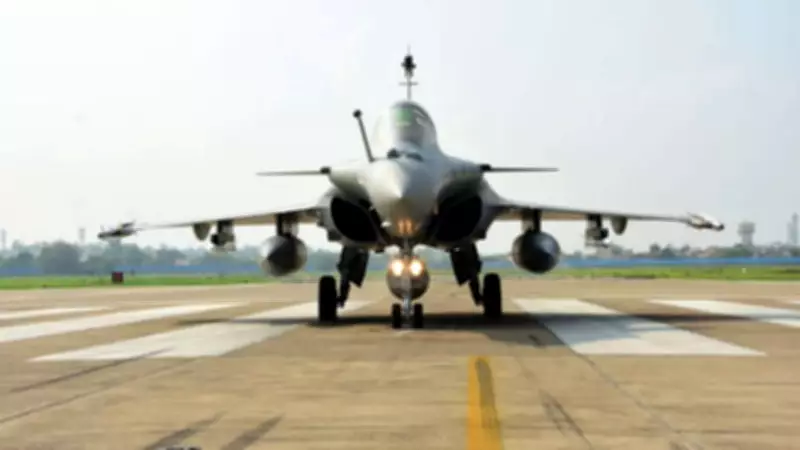
The Ministry of Defence has issued a Letter of Request (LoR) to France for the procurement of 114 Rafale fighters for the Indian Air Force (IAF). The new Rafale deal, expected to cost Rs 3.25 lakh crore, will be a government-to-government agreement between India and France.
Timeline and Production Plan
If the previous deal for 36 Rafale aircraft is used as a benchmark, the Indian Air Force is unlikely to receive its first Rafale for at least four years after signing the contract. However, Dassault's order book for the Rafale has grown significantly, with over 150 aircraft on order. Reports indicate the deal for the fighters is expected to be signed early next year. Of the 114 fighters, 18 will be procured from France in fly-away condition, while the remaining 96 will be produced in India. The first of these 18 aircraft is not expected to reach India before 2032, according to a report.
IAF's Squadron Strength Crisis
This development comes at a time when the Indian Air Force is at a historic low in terms of squadron strength, which currently stands at 29 against an authorized strength of 42.5 squadrons. Even if six squadrons of Rafales are added, the number would rise to only 35 squadrons. The IAF plans to retire the first of the Jaguar squadrons around 2030, and the retirement of MiG-29 and Mirage-2000 fleets is expected by the mid-2030s. This could result in the loss of up to 12 squadrons. Meanwhile, HAL has yet to deliver any of the contracted Tejas Mk-1A fighters due to integration issues and engine delivery delays. The Tejas Mk2 program, which was expected to have its first flight in 2025, is also facing delays and has yet to be rolled out.

Technological and Strategic Considerations
Rafales are potent 4.5-generation multirole fighters, but they cannot alone offset the numerical shortfall, especially in a two-front war scenario. Pakistan fields upgraded J-10s and JF-17s equipped with advanced AESA radars, while China deploys advanced J-16s and fifth-generation J-20s. Technologically, Rafales bring advanced avionics, electronic warfare suites, and precision strike capability. Their AESA radar is based on Gallium Arsenide, while rivals increasingly field Gallium Nitride (GaN) radars with superior range and resilience. Thales, the maker of the Rafale's RBE2 radar, is working on a variant using GaN technology. Heavy reliance on a single imported platform risks overdependence and cost escalation, with estimates of Rs 3.25 lakh crore for 114 aircraft.
Need for Indigenous Programs
Accelerating indigenous programs like the Tejas Mk2 is critical to replace retiring MiGs and Jaguars with a modern fighter. Parallel investment in the Advanced Medium Combat Aircraft (AMCA) will provide stealth capability to counter fifth-generation threats. In essence, 114 Rafales sharpen the IAF's edge but cannot alone solve the understrength force. India's airpower strategy must combine imported quality with indigenous quantity, ensuring a diverse mix of platforms that can credibly handle simultaneous threats from China and Pakistan. The Rafale deal should be seen as one pillar in a broader force-building plan, not the solution in itself. Only by integrating Rafales with Tejas Mk2, AMCA, and UCAVs can the IAF achieve the balanced, future-ready force structure it requires.






