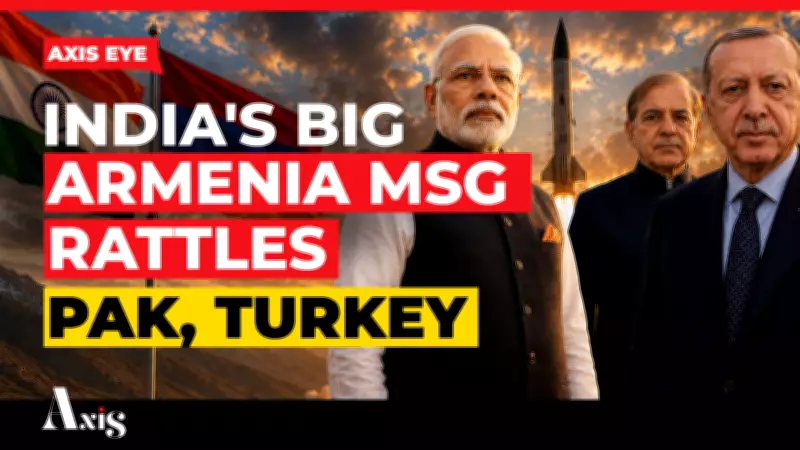
Armenia has turned to India in a massive strategic shift that is reshaping power equations in the South Caucasus. After losing Nagorno-Karabakh and watching Pakistan, Turkey and Azerbaijan deepen military cooperation, Yerevan is now betting heavily on Indian weapons. India has already supplied Pinaka rocket systems, Akash air defence systems, Swathi radars and artillery platforms. Now Armenia is finalising a major deal for Sukhoi-30MKI fighter jets from India. The partnership is worth billions and marks India's rise as a serious global defence exporter.
Strategic Implications Beyond Arms Sales
But this is bigger than arms sales. Pakistan and Turkey openly back Azerbaijan against Armenia, while both countries also support anti-India positions on Kashmir. India's growing military role in Armenia is now being viewed as a strategic counter to the Pakistan-Turkey-Azerbaijan axis. The Caucasus may be far from Kashmir, but the geopolitical battle lines are increasingly connected.
India's Defence Export Ambitions
India's defence export ecosystem has matured significantly, with systems like the Pinaka rocket system and Akash air defence gaining international recognition. The Sukhoi-30MKI deal with Armenia underscores India's capability to supply advanced fighter jets, previously dominated by Russia and Western nations. This move not only strengthens bilateral ties but also positions India as a reliable partner in regions seeking alternatives to traditional suppliers.

The deal is expected to include spare parts, maintenance, and training packages, further deepening defence cooperation. Armenia's pivot to India comes as it seeks to modernise its military after the 2020 Nagorno-Karabakh conflict, where Azerbaijani drones and Turkish support proved decisive.
Geopolitical Chessboard
The India-Armenia partnership is a direct response to the trilateral alliance between Pakistan, Turkey, and Azerbaijan. Pakistan has provided military training and support to Azerbaijan, while Turkey has supplied drones and other weaponry. India's entry into the Caucasus through Armenia creates a new dynamic, balancing the influence of these powers. Analysts note that this aligns with India's broader strategy of countering Pakistan's influence in regions beyond South Asia.
Furthermore, the partnership could open doors for India in other former Soviet republics, as Armenia serves as a gateway to the region. The deal also sends a message to China, which has been expanding its influence in Central Asia and the Caucasus through the Belt and Road Initiative.