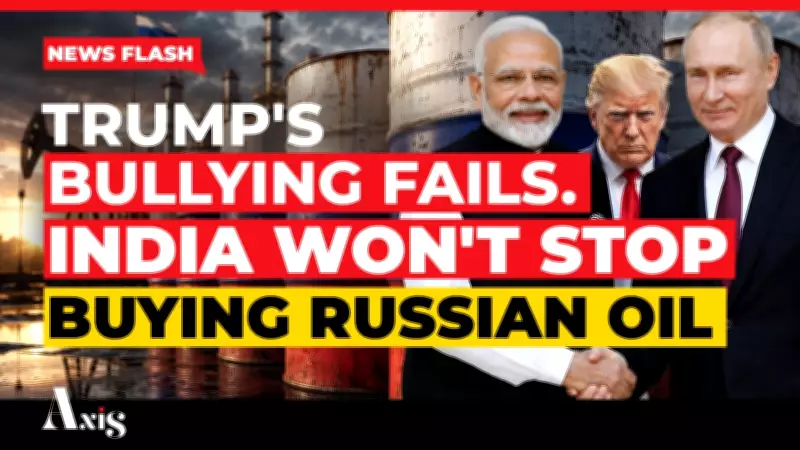
India has delivered one of its strongest signals yet to Washington over Russian oil imports. Despite growing U.S. pressure and the expiry of sanctions waivers linked to Russian seaborne crude, New Delhi says it will continue buying discounted Russian oil because India's energy security comes first.
India's Firm Stand on Energy Security
As global oil markets face uncertainty due to the Iran-Israel-U.S. crisis and rising tensions around the Strait of Hormuz, India is refusing to compromise on affordable energy supplies for its economy. Russian crude imports to India remain near record levels, with shipments crossing 2 million barrels per day. This is not just about geopolitics. It is about economics, inflation, industrial growth and national interest.
Why India Refuses to Bow
The decision to continue importing Russian oil is driven by multiple factors. First, discounted Russian crude helps India manage its current account deficit and keep inflation in check. Second, India's refining capacity is optimized for Russian grades, making a sudden switch costly. Third, reliance on alternative suppliers like the Middle East exposes India to geopolitical risks, especially given the volatility in the Strait of Hormuz.

Russia's Rise as India's Top Oil Supplier
Following the Ukraine war, Russia emerged as India's biggest oil supplier, displacing traditional partners like Iraq and Saudi Arabia. India's imports of Russian oil surged from negligible levels to over 2 million barrels per day, accounting for nearly 40% of total crude imports. This shift has provided India with significant cost savings, estimated at billions of dollars annually.
The Expired Sanctions Waiver
The U.S. had granted a temporary sanctions waiver for imports of Russian seaborne crude, but it expired recently. Washington has since intensified pressure on India to reduce purchases, citing the need to limit Russia's oil revenues used for its war in Ukraine. However, India has maintained that its energy purchases are a matter of national interest and not subject to external dictates.
Implications for India-U.S. Ties
India's stance has created friction in the otherwise strong India-U.S. strategic partnership. While both countries share common interests in the Indo-Pacific and defense cooperation, energy policy remains a point of divergence. The U.S. has warned of potential repercussions, but India has signaled that it will not compromise its energy security.
Impact on Global Oil Markets
India's continued demand for Russian oil has helped stabilize global prices by providing an outlet for Russian crude that would otherwise be subject to Western sanctions. This has also allowed Russia to maintain production levels, preventing a sharper spike in energy costs worldwide. However, it has also complicated efforts by the U.S. and its allies to isolate Russia economically.
Future of Energy Geopolitics
India's decision could set a precedent for other nations, particularly in the Global South, to prioritize national interests over Western-led sanctions regimes. As energy markets evolve, the balance of power in global oil trade may shift, with countries like India playing a more assertive role in shaping the rules.