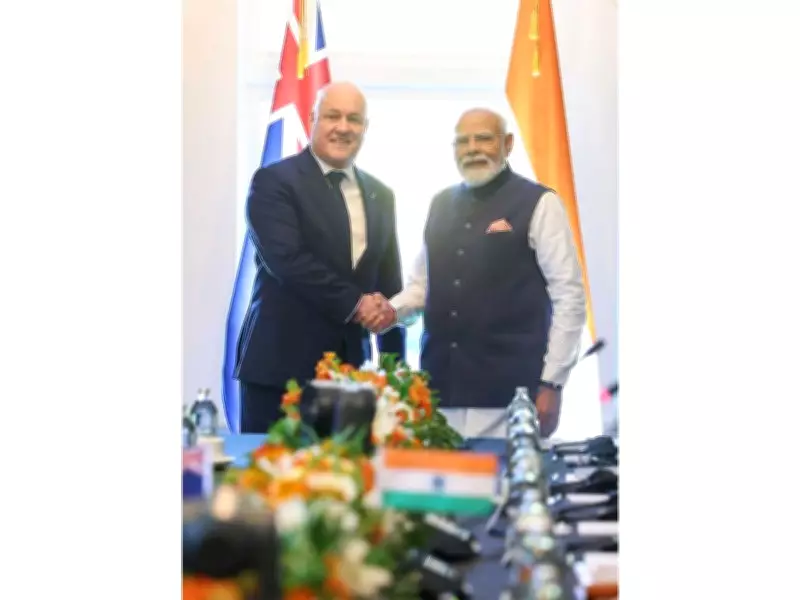
India and New Zealand have unveiled a comprehensive 'Roadmap to 2030' to significantly deepen defence and security cooperation over the next four years. The roadmap was endorsed during a high-level meeting between Prime Minister Narendra Modi and his New Zealand counterpart Christopher Luxon in Auckland on Saturday, following the formal elevation of bilateral ties to a Strategic Partnership.
Key Pillars of the Roadmap
The landmark blueprint places a heavy emphasis on maritime security, counter-terrorism, and cyber defence under its critical Pillar II framework. Under the roadmap, both countries agreed to continue military interaction via exercises, visits of units (maritime, air, land), short-term personnel exchanges, sporting visits, defence staff college exchanges, and high-level defence dialogues. They also committed to enhance dialogue on defence-related matters, including at the ministerial level.
The roadmap also commits both sides to continue implementing the 2025 India-New Zealand Memorandum of Understanding on Defence Cooperation and maintain regular, structured defence engagement at Defence Ministry and Service levels. Efforts to formalise cooperation on combating narcotics trafficking and strengthen law enforcement cooperation, including between India's National Investigation Agency (NIA) and the New Zealand Police, are also included.

Annual Maritime Security Dialogue Established
As part of the major security overhaul, both nations have agreed to establish an annual Maritime Security Dialogue led by the Ministry of External Affairs (MEA) of India and the Ministry of Foreign Affairs and Trade (MFAT) of New Zealand. The joint statement welcomed cooperation under Combined Task Force 150 (CTF-150) in 2025, with New Zealand in command and India as Deputy Commander, supporting efforts to deter narcotics smuggling, terrorism, and illicit maritime activity in the Middle East and the Western Indian Ocean.
India welcomed New Zealand's nomination of Maritime Security as its priority pillar under the Indo-Pacific Oceans Initiative. The two sides will immediately implement a recently agreed Maritime Cooperation Arrangement, an Implementing Arrangement on Cooperation in Matters of Hydrography and Nautical Cartography, and a Mutual Logistics Support Arrangement focused specifically on the maritime domain. Under this framework, both nations will routinely conduct naval activities, including bilateral naval exercises.
Counter-Terrorism and Cyber Security Cooperation
To institutionalise their counter-terror apparatus, the roadmap mandates the operationalisation of the newly signed Memorandum of Arrangement establishing a Joint Working Group (JWG) on Counter-Terrorism, with its maiden meeting scheduled to be convened shortly. The two prime ministers also reaffirmed their shared commitment to strengthening cooperation on counter-terrorism, cyber security, and related security challenges. They agreed to strengthen practical law enforcement cooperation to combat transnational and organised crime, including illicit drug trafficking, financial crime, cyber-enabled crime, terrorism-related offences, people smuggling, and trafficking in persons.
In a bid to expand law enforcement and intelligence networking, India and New Zealand have resolved to work towards the formalisation of a Memorandum of Arrangement between the NIA and the New Zealand Police.