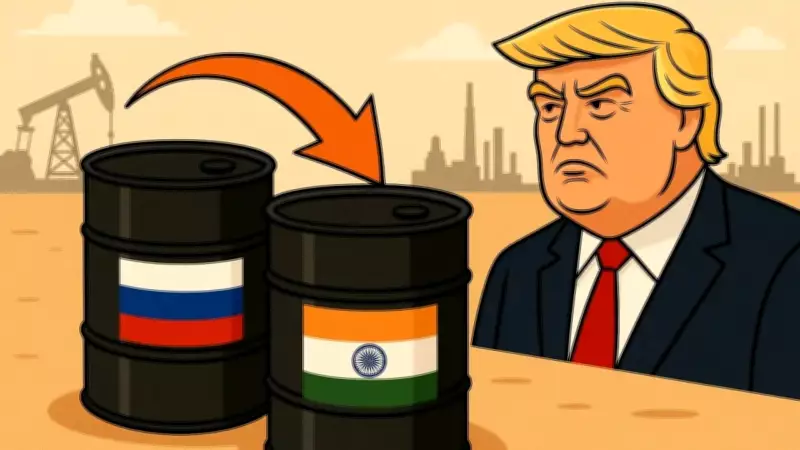
The Donald Trump administration may have allowed the sanctions waiver on Russian crude to expire on May 16, but India has made it clear that it will continue to procure oil from Moscow. The sanctions waiver by the US enabled countries such as India to continue purchasing Russian crude transported by sea. The waiver had been extended for a month to help ease supply shortages and elevated oil prices caused by Iran’s closure of the Strait of Hormuz.
India's Stance on Russian Oil Imports
Speaking at a media briefing, Sujata Sharma, joint secretary in the petroleum ministry, said India had sourced oil from Russia before the waiver period, during the waiver, and continues to procure it now as well. “Regarding the American waiver on Russia, I would like to emphasise that we have been purchasing from Russia earlier... before waiver also, during waiver also, and now also,” Sujata Sharma reportedly said. She noted that India’s crude procurement strategy is guided mainly by commercial logic and the availability of sufficient supplies.
According to Sharma, the country has secured adequate crude volumes through long-term arrangements, and there is currently no shortage of supplies. Sharma maintained that the continuation or expiry of the waiver would not affect the availability of crude oil for India. The earlier extension formed part of a broader strategy by the Trump administration to manage soaring global energy prices amid the ongoing Iran conflict. India remains the largest buyer of Russian seaborne crude, with imports touching near-record levels in April and May following previous sanctions-related relaxations.

Why India Won't Stop Buying Russian Crude Oil
Sumit Ritolia, Manager Modelling and Refining at Kpler, lists six reasons:
- Supply Security and Economics: Even with the waiver uncertainty, it remains difficult to see India materially stepping back from Russian barrels. The issue is no longer purely about sanctions optics, but increasingly about supply security and economics in a much more fragile global crude system.
- Geopolitical Uncertainty: With continued geopolitical uncertainty and the Strait of Hormuz situation still far from normal, including restricted transits, higher freight risk, and slower flows, Middle Eastern barrels are no longer as straightforward or secure as they were previously. In that environment, Russian crude continues to offer a clear advantage through both pricing and relatively stable logistics via non-Strait routes.
- Compliance Mechanisms: With the waiver lapsing, flows are likely to remain broadly stable, although they could ease modestly from March levels. A key distinction often missed is this: Russian oil itself is not sanctioned, but certain entities, vessels, and financial channels are. Russia will continue to be a core supplier for India, but procurement must strictly ensure: no involvement of sanctioned sellers or intermediaries, use of non-sanctioned vessels, and fully compliant financial, insurance, and trading channels.
- Operational Adjustments: India is unlikely to move away from Russian crude in the near term. Instead, we should expect more documentation and tighter screening rather than a structural shift in sourcing.
- Limited Alternatives: Russia is expected to remain central to India’s crude slate. There are limited alternatives available at similar scale and pricing, particularly in a market still dealing with geopolitical uncertainty and uneven Middle Eastern flows. The adjustment is therefore more likely to be operational rather than structural, with refiners favoring near-term loaded cargoes and avoiding directly sanctioned entities rather than materially stepping away from Russian crude altogether.
- Tactical Understanding: Kpler even suggests that there might be some sort of tactical understanding that India keeps importing Russian energy, which has been the backbone for India's energy security since the start of the war.
India's continued procurement of Russian crude underscores its focus on energy security and commercial pragmatism, even as global sanctions dynamics evolve.