

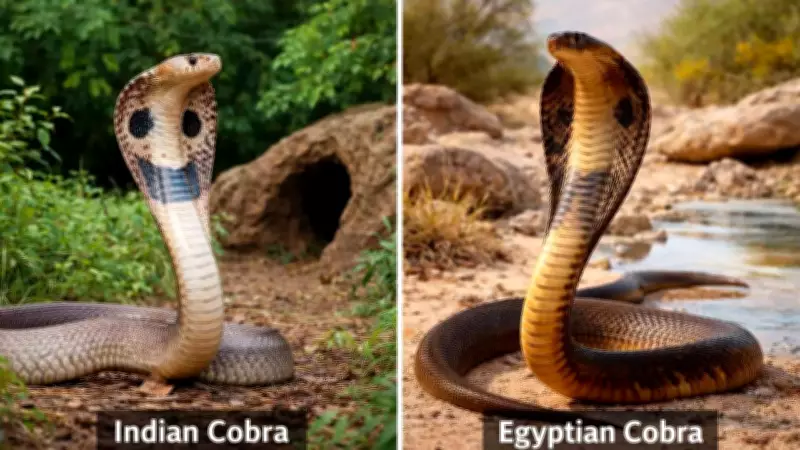
Indian vs Egyptian Cobra: A Comprehensive Comparison
Cobras are widely recognized as some of the most iconic venomous snakes globally, distinguished by their raised posture and flared hoods. This unique appearance has cemented their place in history and folklore across various cultures. Among the numerous species, the Indian Cobra (Naja naja) and the Egyptian Cobra (Naja haje) stand out as two of the most common and fascinating members of the cobra family.
Geographical Distribution and Habitat
The Indian cobra inhabits a broad range across the Indian subcontinent, including countries such as India, Pakistan, Sri Lanka, Bangladesh, and Nepal. This adaptable species thrives in diverse environments, from forests and grasslands to wetlands and agricultural areas. It often seeks shelter in termite hills, rock crevices, dense vegetation, and abandoned burrows, leading to frequent encounters in rural settings.
In contrast, the Egyptian cobra is native to North Africa and the Arabian Peninsula, with populations in Egypt, Sudan, and neighboring regions. It prefers arid or semi-arid habitats like savannas, rocky terrains, and desert fringes, typically staying near water sources that support its prey.

Physical Characteristics and Size
While both species share the characteristic hood, they exhibit notable differences in size and appearance. The Indian cobra averages 1 to 1.5 meters in length, with some individuals reaching up to 2 meters. A key identifying feature is the spectacle-shaped marking on the back of its hood, which resembles eyeglasses and gives it the nickname "spectacled cobra."
The Egyptian cobra is generally larger and heavier, with lengths ranging from 1.5 to 2 meters and some specimens extending to 2.4 meters. It lacks the spectacle marking and displays color variations from yellowish-brown to dark brown or black, depending on its habitat.
Venom Potency and Snakebite Risks
Both cobras possess potent neurotoxic venom that targets the nervous system. The Indian cobra's venom contains neurotoxins and cardiotoxins, which can cause breathing difficulties, paralysis, and even death if untreated. It is classified among the "big four" medically significant snakes in India due to its high bite incidence.
Similarly, the Egyptian cobra's venom induces muscle paralysis and respiratory failure, posing life-threatening risks without prompt medical intervention. Despite their dangerous reputation, both species typically avoid human contact and only bite when provoked or threatened.
Hunting Behavior and Diet
As carnivorous predators, Indian and Egyptian cobras feed on small animals. The Indian cobra primarily hunts rodents, frogs, lizards, and birds, playing a crucial role as a natural pest controller in agricultural areas. The Egyptian cobra has a similar diet but, due to its larger size, can occasionally tackle bigger prey such as small mammals and reptiles.
Both species rely on venom to subdue their prey, striking and injecting toxins before waiting for the prey to succumb, after which they swallow it whole.
Defensive Mechanisms and Behavior
Cobras are renowned for their defensive displays, which involve raising the front of their bodies and expanding their hoods to appear larger. This behavior, accompanied by hissing and swaying, serves as a warning to potential threats. Both Indian and Egyptian cobras employ this tactic, often opting to flee rather than attack unless cornered.
Cultural and Historical Significance
The Indian cobra holds deep cultural roots in South Asia, frequently associated with Hindu deities like Lord Shiva. In Egyptian history, the cobra symbolizes royalty and protection, depicted as the uraeus on pharaohs' crowns. These cultural ties highlight the enduring fascination with these reptiles worldwide.
Understanding the differences between Indian and Egyptian cobras not only sheds light on their ecological roles but also underscores their importance in both natural and human contexts.






